
10 Active Learning Strategies to Boost Engagement in 2025
Traditional learning models often position students as passive recipients of information. Information is delivered, memorized, and then tested. But how much of that knowledge truly sticks? The answer, increasingly, is "not enough." To build deep, lasting comprehension, especially in complex fields like IT and computer science, learners must move from passively listening to actively doing. This is the core principle of active learning, a pedagogical approach that fundamentally changes the student's role from observer to participant.
This article shifts the focus from theory to practice. We will explore ten powerful active learning strategies that you can implement immediately to transform your study sessions or classroom environments. For each strategy, we provide a clear breakdown of what it is, why it works, and actionable steps for implementation. You will find concrete examples tailored for technical subjects, from preparing for a vendor certification to mastering a new programming language. Forget abstract concepts; this is a practical playbook for engaging with material more effectively, retaining more knowledge, and developing the critical problem-solving skills necessary for a successful career. Get ready to move beyond the lecture and actively construct your own understanding.
1. Think-Pair-Share
Think-Pair-Share is a foundational active learning strategy that structures classroom discussion to ensure universal participation. Popularized by Frank Lyman, this method transforms passive listeners into active contributors by breaking down complex questions into three manageable phases: individual reflection (Think), collaborative discussion (Pair), and group-wide reporting (Share). This structured approach encourages students to formulate their own thoughts before being influenced by others, fostering deeper critical thinking and more confident participation.
 Think-Pair-Share
This technique is remarkably versatile. For IT professionals studying for certifications, it can be used to analyze complex network diagrams or debug code snippets. In a corporate training setting, teams could use it to brainstorm solutions to a business case study before presenting their final recommendations.
How to Implement Think-Pair-Share
- Think (1-2 minutes): Pose a specific, open-ended question. For example, "What are the primary security vulnerabilities in this code block?" Give students silent time to formulate their individual answers.
- Pair (3-5 minutes): Instruct students to turn to a partner and discuss their thoughts. This small-group setting is a low-stakes environment for students to test, refine, and articulate their ideas.
- Share (5-10 minutes): Ask pairs to share their key takeaways with the larger group. Encourage them to build on each other’s ideas rather than simply repeating them. As an instructor, you can facilitate this by calling on different pairs to contribute unique points.
Pro Tip: For remote or hybrid learning, leverage breakout rooms for the "Pair" phase. The HydraNode platform’s integrated collaboration tools can facilitate seamless transitions between individual work and small-group discussions, making this one of the most adaptable active learning strategies.
2. Problem-Based Learning (PBL)
Problem-Based Learning (PBL) is an active learning strategy where students gain knowledge and skills by working to investigate and resolve a complex, real-world problem. Pioneered by McMaster University Medical School, this student-centered approach shifts the instructor's role from a lecturer to a facilitator. Students, typically in small groups, define their own learning objectives, conduct research, and collaboratively develop solutions, fostering deep understanding and practical application of concepts.
 Problem-Based Learning (PBL)
This method is highly effective in technical and professional fields. For instance, medical students use PBL to diagnose patient cases, while engineering students might tackle a real industry design challenge. In a corporate IT setting, a team could use PBL to troubleshoot a persistent, system-wide network outage, forcing them to learn about underlying protocols and hardware limitations in the process.
How to Implement Problem-Based Learning
- Present the Problem: Introduce an ill-structured, authentic problem. For example, "Your company's cloud spending has unexpectedly increased by 40%. Identify the root causes and propose a cost-optimization plan."
- Identify Learning Needs: Guide groups as they analyze the problem, list what they know, and determine what they need to learn to solve it. This step is crucial for self-directed learning.
- Conduct Research and Apply Knowledge: Students independently and collaboratively research their identified learning needs. They then reconvene to apply their new knowledge to formulate a solution or recommendation.
- Present and Debrief: Groups present their findings and solutions. The session concludes with a debrief led by the facilitator to consolidate learning and reflect on the problem-solving process.
Pro Tip: The success of PBL depends on the quality of the problem. Use the HydraNode scenario generator to create complex, industry-relevant problems that are appropriately challenging for your learners. This ensures authenticity and aligns the learning experience with real-world job demands.
3. Flipped Classroom
The Flipped Classroom is a powerful pedagogical model that inverts the traditional teaching structure to maximize in-person engagement. Pioneered by educators like Jonathan Bergmann and Aaron Sams, this approach moves direct instruction from the group learning space to the individual learning space. Core content is delivered outside of class through videos or readings, freeing up valuable class time for interactive, collaborative, and hands-on problem-solving activities.
 Flipped Classroom
This model is one of the most effective active learning strategies for technical and complex subjects. For example, computer science students can watch coding tutorials before a lab session, arriving ready to program with instructor support. Likewise, medical students might review anatomy videos before a hands-on lab, allowing them to focus on practical application rather than basic memorization during class.
How to Implement a Flipped Classroom
- Create or Curate Pre-Class Content: Record short, focused videos (5-10 minutes is ideal) or assign specific readings that cover foundational concepts. Ensure the content is easily accessible.
- Establish Accountability: Include a simple, low-stakes quiz or a required discussion board post related to the pre-class material. This ensures learners come to class prepared to engage.
- Design In-Class Activities: Plan activities that build directly on the pre-class content. This could include group problem-solving, case study analysis, peer instruction, or project-based work where the instructor acts as a facilitator.
Pro Tip: In a corporate setting, use a flipped approach for new software training. Have teams watch tutorials on basic functions beforehand, then use the live session for advanced, role-specific use cases and Q&A. The HydraNode platform can host pre-class video modules and track completion, seamlessly setting the stage for productive in-person or virtual collaboration.
4. Peer Instruction
Peer Instruction is an evidence-based, interactive teaching method that turns lectures into engaging learning experiences. Developed by Harvard physics professor Eric Mazur, this strategy centers on asking students conceptual questions, having them commit to an answer individually, and then discussing their reasoning with a neighbor. This process forces students to confront and resolve misconceptions through peer-to-peer dialogue, making it one of the most effective active learning strategies for building deep conceptual understanding.
 Peer Instruction
This method shines in technical fields where foundational concepts are critical. In a computer science class, it can be used to explore how different sorting algorithms handle edge cases. For corporate training on new software, it helps employees clarify their understanding of core functionalities before moving on to more complex tasks, ensuring a solid knowledge base across the team.
How to Implement Peer Instruction
- Initial Instruction & Question (2-3 minutes): Briefly present a concept, then pose a challenging multiple-choice conceptual question (often called a ConcepTest). Students think and record their individual answers using clickers, polling software, or just raising their hands.
- Peer Discussion (2-4 minutes): If the initial response rate of correct answers is between 30% and 70%, instruct students to find a neighbor with a different answer and try to convince them of their reasoning. This is the core of the learning process.
- Revote and Explain (3-5 minutes): After the discussion, have all students vote again. The number of correct answers almost always increases significantly. You then lead a class-wide discussion, explaining the correct answer and addressing any lingering confusion revealed by the polling data.
Pro Tip: The quality of your conceptual question is paramount. Design questions that target common misunderstandings. The HydraNode platform can help by analyzing student performance data to identify these common sticking points, allowing you to create highly effective ConcepTests that drive meaningful peer discussions.
5. Case-Based Learning
Case-Based Learning (CBL) is an instructional approach that anchors learning in the analysis of real-world or realistic scenarios. Pioneered by institutions like Harvard Business School, this method challenges students to move beyond theory and apply their knowledge to complex, authentic problems. By dissecting intricate cases, learners develop critical thinking, problem-solving skills, and a nuanced understanding of professional decision-making. This is one of the most effective active learning strategies for bridging the gap between academic knowledge and practical application.
This method is incredibly powerful across various disciplines. Law schools use it to analyze legal precedents, medical schools rely on patient cases to develop clinical reasoning, and IT professionals can use it to diagnose a complex system failure or evaluate the trade-offs of different cloud architecture designs. It forces learners to confront the ambiguity and incomplete information that characterize real-life challenges.
How to Implement Case-Based Learning
- Select the Right Case: Choose a case that is complex enough to allow for deep analysis but is clearly aligned with your specific learning objectives. Ensure it presents a genuine dilemma without one obvious "right" answer.
- Provide Context and Questions: Give students the case details along with sufficient background information. Frame their analysis with a set of guiding questions, such as "What is the core problem here?" or "What are the potential consequences of each possible action?"
- Facilitate Discussion: Guide a group discussion where students present their analysis, justify their reasoning, and debate different solutions. Your role is to moderate, challenge assumptions, and ensure multiple perspectives are explored.
Pro Tip: For technical training, use HydraNode’s simulation labs to create dynamic, interactive cases. You can present a cybersecurity breach scenario and have learners actively investigate the incident within a safe, sandboxed environment, turning a static case study into a hands-on diagnostic challenge.
6. Inquiry-Based Learning
Inquiry-Based Learning is a powerful, student-centered approach that shifts the focus from the instructor providing answers to the student asking questions. Championed by educational pioneers like John Dewey, this method empowers learners to formulate their own questions, investigate complex topics, and construct new knowledge through exploration and discovery. This process transforms students into active architects of their own understanding, fostering curiosity, critical thinking, and intellectual independence.
This strategy is highly effective in technical fields where problem-solving is paramount. A cybersecurity student might use it to investigate the root cause of a specific data breach, while a team of junior developers could apply it to explore the performance implications of different database query structures. By owning the investigation process, learners develop deeper, more durable knowledge.
How to Implement Inquiry-Based Learning
- Formulate Questions: Start by presenting a broad scenario or phenomenon. Guide students to develop specific, investigable questions. For example, instead of explaining a network outage, ask, "What potential factors could lead to a cascading failure in this network topology?"
- Investigate and Explore: Provide resources and scaffolding to support the investigation. This could include access to technical documentation, lab environments, or case studies. The goal is to facilitate discovery, not provide direct answers.
- Present and Discuss Findings: Create a forum for students to share what they have discovered. Encourage them to present their evidence, explain their reasoning, and discuss the conclusions they have drawn. This sharing phase solidifies learning and exposes the group to diverse perspectives.
Pro Tip: Begin with structured inquiry, where you provide the question and a clear process, before moving to open inquiry, where students generate their own questions and design their own investigations. HydraNode’s sandboxed lab environments are perfect for this, allowing safe, hands-on exploration without risking live systems.
7. Collaborative Learning
Collaborative Learning is a structured educational approach where students work together in small groups toward a shared learning goal. Pioneered by figures like David and Roger Johnson, this method goes beyond simple group work by emphasizing positive interdependence and individual accountability. Every member's contribution is essential for the group's success, fostering a dynamic where students teach and learn from one another, enhancing both academic understanding and crucial interpersonal skills.
This strategy is highly effective in complex, project-based fields. For instance, engineering design teams can use it to develop a prototype over a semester, or a cybersecurity team in training could collaborate to respond to a simulated network intrusion. The core principle is that collective intelligence and shared responsibility lead to a more robust and comprehensive learning outcome than individual effort alone.
How to Implement Collaborative Learning
- Form Diverse Groups: Intentionally create groups with a mix of skills, backgrounds, and perspectives. This diversity enriches the problem-solving process and exposes students to different ways of thinking.
- Establish Clear Roles: Assign specific roles within each group, such as a facilitator, a note-taker, a time-keeper, or a presenter. This ensures all members are actively involved and understand their responsibilities.
- Build-in Accountability: Grade both the final group project and each individual's contribution. This can be done through peer evaluations, individual quizzes on the material, or requiring each member to submit a specific component of the work.
Pro Tip: Explicitly teach collaboration skills before the task begins. Use HydraNode's project management features to create shared workspaces where teams can assign tasks, track progress, and communicate effectively, ensuring that these active learning strategies are seamlessly integrated into your curriculum.
8. Gamification
Gamification is an active learning strategy that applies game design principles and elements to non-game contexts to boost motivation and engagement. Popularized by experts like Jane McGonigal and Karl Kapp, this method leverages competition, achievement, and narrative to make learning more interactive and enjoyable. By incorporating points, badges, leaderboards, and quests, instructors can transform standard course material into a compelling experience that encourages persistence and mastery.
This strategy is highly effective in technical fields. IT professionals could earn badges for mastering specific cybersecurity protocols, while a software development bootcamp might use a leaderboard to track progress on coding challenges. This approach frames learning not as a chore, but as a series of rewarding challenges to overcome, tapping into intrinsic human desires for achievement and progress.
How to Implement Gamification
- Define Clear Objectives: Start by identifying the specific learning outcomes you want to achieve. Ensure every game element, from points to quests, directly supports these goals. For instance, a "debugging quest" should directly test and reinforce a student's ability to identify and fix code errors.
- Introduce Game Mechanics: Integrate elements like a point system for completing tasks, badges for mastering concepts, and a leaderboard to foster friendly competition. Create a narrative or story that connects the learning modules into a cohesive journey.
- Balance Competition and Collaboration: While leaderboards can motivate some learners, they can discourage others. Incorporate team-based challenges or collaborative quests where students must work together to succeed, catering to different motivational styles.
Pro Tip: Use gamification to visualize progress. The HydraNode platform allows you to create customized learning paths with clear milestones, which can be presented as levels or stages in a game. Awarding digital badges upon completion of a module gives learners a tangible and shareable marker of their achievement.
9. Service Learning
Service Learning is an experiential education approach that extends learning beyond the classroom by integrating meaningful community service with academic instruction and structured reflection. Drawing on the philosophies of experiential learning popularized by John Dewey, this strategy enables participants to apply theoretical knowledge to real-world problems. By engaging in activities that address genuine community needs, learners develop not only academic skills but also a strong sense of civic responsibility and a deeper, more contextualized understanding of course material.
This method is highly effective for applying complex skills in a meaningful context. For instance, computer science students could develop a records-management application for a local food bank, or cybersecurity trainees might conduct a vulnerability assessment for a small nonprofit. These hands-on projects make learning tangible and impactful, solidifying concepts far more effectively than theoretical exercises alone. This is one of the most powerful active learning strategies for building both technical competence and social awareness.
How to Implement Service Learning
- Establish Partnerships: Forge genuine, reciprocal partnerships with community organizations. Ensure the project meets a real community-identified need and that the scope is realistic for both students and the partner.
- Align with Objectives: Clearly connect the service activities to specific learning objectives. For example, if the goal is to master database design, the project must involve creating and managing a database.
- Integrate Reflection: Schedule regular reflection activities (journals, group discussions, presentations) before, during, and after the service. This helps students connect their experiences to course content and personal growth.
- Prepare Students: Provide students with context about the community and organization they will be working with. Prepare them for any cultural or social dynamics they might encounter to ensure a respectful and effective engagement.
Pro Tip: Use a centralized platform like HydraNode to manage service-learning projects. Teams can use its project management boards to track tasks, its collaborative workspaces to co-author documentation, and its video conferencing tools to meet with community partners, keeping the entire project organized and on track.
10. Active Learning Classrooms (Studio-Based Learning)
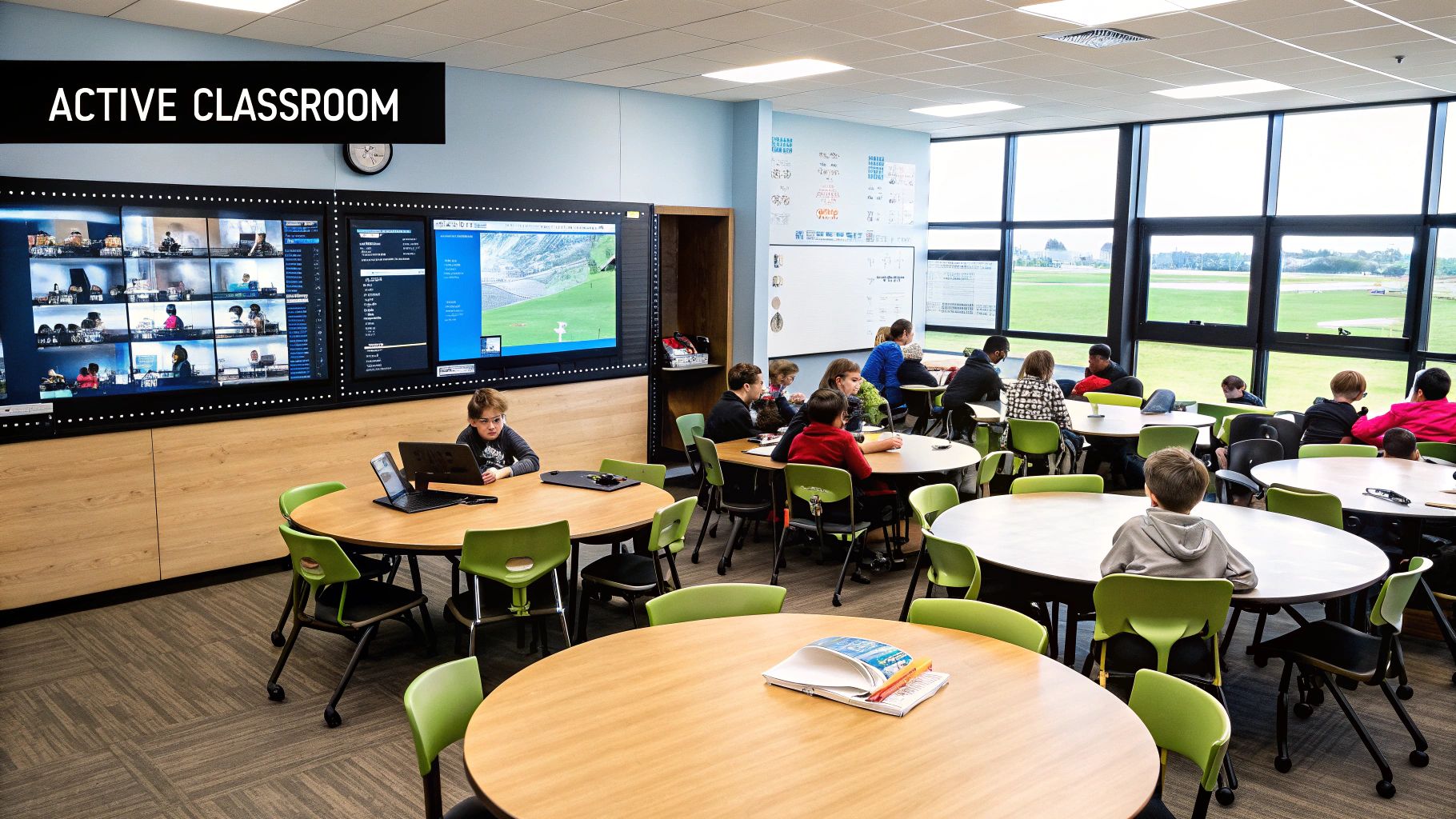
Active Learning Classrooms (ALCs), also known as studio-based learning environments, fundamentally redesign the physical space to prioritize interaction, collaboration, and hands-on problem-solving. Pioneered by initiatives like North Carolina State University's SCALE-UP and MIT's TEAL projects, this approach replaces traditional lecture-hall rows with flexible furniture, multiple displays, and integrated technology to support group work. The instructor shifts from being a "sage on the stage" to a "guide on the side," facilitating learning as students tackle complex problems together.
This model is exceptionally effective for technical and project-based fields. For instance, a cybersecurity class could use an ALC to have teams work at different pods, each simulating a part of a corporate network, to collaboratively identify and patch vulnerabilities. In a software development bootcamp, teams could use the space to design, code, and test an application, using shared screens to present progress and receive real-time feedback. These environments make active learning strategies not just an activity, but the default mode of operation.
How to Implement Active Learning Classrooms
- Design the Space for Collaboration: Arrange tables in pods or clusters to facilitate group work. Ensure each group has access to a shared whiteboard or digital display for brainstorming and presentation.
- Structure Activities, Not Lectures: Design tasks that require students to actively engage with course material. Instead of lecturing on network protocols, create a challenge where teams must configure a virtual network to meet specific requirements.
- Integrate Technology Seamlessly: Equip the room with reliable Wi-Fi, power sources for devices, and simple-to-use screen-sharing technology. The focus should be on the learning activity, not on fighting with the tech.
- Provide Instructor Training: Transitioning to an ALC requires a pedagogical shift. Offer faculty development to help instructors design effective collaborative activities and learn to manage a dynamic, student-centered classroom.
Pro Tip: You don't need a multi-million dollar renovation to start. Begin by rearranging furniture in a traditional classroom to create group pods. HydraNode's platform can serve as the digital backbone of your DIY active learning space, allowing teams to collaborate on virtual labs and share their screens from any device, effectively mimicking a high-tech ALC.
Active Learning Strategies Comparison Matrix
| Teaching Method | Implementation Complexity (🔄) | Resource Requirements (⚡) | Expected Outcomes (📊⭐) | Ideal Use Cases (💡) | Key Advantages (⭐💡) |
|---|---|---|---|---|---|
| Think-Pair-Share | Low - simple 3-phase process 🔄 | Minimal - no special tech or prep ⚡ | Increased participation, confidence, communication skills 📊⭐ | Building discussion skills, concept exploration 💡 | Encourages engagement, quick feedback, suits all class sizes ⭐ |
| Problem-Based Learning (PBL) | High - requires complex problem design 🔄 | High - time, facilitator guidance, resources ⚡ | Critical thinking, problem-solving, motivation 📊⭐ | Professional/applied disciplines 💡 | Develops lifelong learning, real-world relevance ⭐ |
| Flipped Classroom | Moderate - prep of videos and materials 🔄 | Moderate - tech tools, content creation ⚡ | More active class time, personalized learning 📊⭐ | Courses with foundational content and skills 💡 | Maximizes instructor-student interaction, student pacing ⭐ |
| Peer Instruction | Moderate - question design, facilitation 🔄 | Moderate - clickers or polling tech ⚡ | Immediate misconception correction, engagement 📊⭐ | STEM courses focusing on conceptual understanding 💡 | Real-time feedback, peer explanation, enhanced engagement ⭐ |
| Case-Based Learning | High - case development and facilitation 🔄 | Moderate to high - case materials, prep ⚡ | Critical thinking, application of theory 📊⭐ | Business, medicine, law, social work 💡 | Bridges theory and practice, engaging scenarios ⭐ |
| Inquiry-Based Learning | High - scaffolding and open-ended guidance 🔄 | Variable - materials vary, may be high ⚡ | Independent research skills, curiosity, deep understanding 📊⭐ | Science, social studies, research disciplines 💡 | Promotes discovery and intrinsic motivation ⭐ |
| Collaborative Learning | Moderate - group setup and management 🔄 | Low to moderate - space and group coordination ⚡ | Communication, teamwork, deeper learning 📊⭐ | Small group work across disciplines 💡 | Builds interpersonal skills, exposes to diversity ⭐ |
| Gamification | High - design and tech integration 🔄 | Moderate to high - platforms, rewards ⚡ | Increased motivation and engagement 📊⭐ | Diverse settings needing motivation boost 💡 | Engages varied learners, immediate feedback, fun ⭐ |
| Service Learning | High - coordination, partnerships 🔄 | High - logistics, community collaboration ⚡ | Civic responsibility, real-world impact 📊⭐ | Community-focused, civic education 💡 | Combines academics with service, empathy, social skills ⭐ |
| Active Learning Classrooms | High - space redesign, tech setup 🔄 | Very high - physical space, technology ⚡ | Collaboration, dynamic learning environments 📊⭐ | STEM and project-based courses 💡 | Enhances peer/instructor interaction, multiple learning styles ⭐ |
Putting it All Together: Building Your Active Learning Toolkit
Moving beyond passive listening and rote memorization is no longer an optional upgrade; it is the essential operating system for modern learning. Throughout this guide, we've explored ten powerful active learning strategies, from the quick, collaborative burst of Think-Pair-Share to the immersive, real-world application of Service Learning. Each method offers a unique pathway to transform inert information into dynamic, usable knowledge.
The core principle connecting all these techniques is simple yet profound: learning is not a spectator sport. True comprehension and long-term retention happen when learners are actively engaged in the process. They must be challenged to question, collaborate, solve problems, and construct their own understanding. This shift from knowledge consumption to knowledge creation is the most critical takeaway.
Key Takeaways for Building Your Strategy
As you begin integrating these methods, remember that the goal isn't to use every strategy at once. Instead, the objective is to build a versatile and adaptable toolkit. Consider these core principles as your guide:
- Context is King: The best strategy depends entirely on your learning objectives, the complexity of the material, and the needs of your audience. Case-Based Learning excels for analytical skill development, while Gamification can be a powerful motivator for mastering foundational concepts.
- Start Small and Iterate: You don't need to completely overhaul your teaching or study methods overnight. Begin by introducing a Think-Pair-Share activity into a lecture or converting a single lesson into a Flipped Classroom model. Measure the results, gather feedback, and refine your approach.
- Technology as an Enabler: Tools are not a substitute for sound pedagogy, but they can be powerful amplifiers. As we've seen, platforms like HydraNode can streamline the implementation of Flipped Classrooms, facilitate rich Problem-Based Learning scenarios, and support complex Collaborative Learning projects.
Your Actionable Next Steps
Mastering these active learning strategies is a journey of continuous improvement that yields significant rewards. Whether you are an IT professional aiming for a new certification, a computer science student tackling complex algorithms, or an educator designing the next generation of training, the benefits are clear. You will achieve deeper understanding, longer-lasting knowledge retention, and a more developed set of critical thinking and problem-solving skills that are invaluable in today's tech landscape.
The transition from passive to active learning requires intentional effort, but the payoff is a more resilient, adaptable, and ultimately more effective approach to education. Begin today by selecting one strategy from this list that resonates with your immediate goals. Plan how you will implement it, define what success looks like, and take that first step. Your future self will thank you for it.
Ready to supercharge your active learning environment with cutting-edge AI? HydraNode provides the integrated tools you need to build dynamic labs, manage Flipped Classrooms, and deploy complex Problem-Based Learning scenarios with ease. Explore how our platform can transform your training and educational programs by visiting HydraNode today.