
Achieve Your Oracle Cloud Computing Certification Today!
An Oracle cloud computing certification is more than just a piece of paper. It's a credential that proves you have hands-on skills with Oracle Cloud Infrastructure (OCI), instantly making you a more valuable and sought-after professional. Think of it as a direct ticket to specialized roles in cloud architecture and data management, often with a significant salary bump and better job security to match.
Why Oracle Cloud Certification Is a Smart Career Move
 Image
Image
Let's cut to the chase: Is an Oracle Cloud certification actually worth your time and effort? In my experience, the answer is a definitive yes. In a world where cloud fluency is table stakes, having verified OCI skills on your resume is a powerful way to stand out. It tells potential employers you’re ready to handle enterprise-grade workloads on a secure, high-performance platform.
Many organizations, especially those with a long history of using Oracle databases and applications, are making the leap to OCI for their core operations. This shift creates a massive, immediate demand for people who know the ecosystem inside and out. An official certification is your proof that you’re one of those people.
Connecting Your Certification to Real-World Demand
This isn't just some passing trend; it's a fundamental change in how businesses run. I see it all the time on job boards, OCI certifications are now often listed as a hard requirement, not just a "nice-to-have."
- Cloud Architects: To land a senior role designing and deploying resilient, scalable solutions on OCI, the OCI Architect Professional certification is practically a prerequisite.
- DevOps Engineers: An OCI DevOps Professional certification demonstrates you can build and manage CI/CD pipelines, bridging the gap between development and operations right on Oracle's cloud.
- Database Administrators: For DBAs, the OCI Database Management Professional certification has become essential for managing Autonomous Databases and other modern, cloud-native data services.
This direct line from certification to high-impact roles makes it one of the clearest investments you can make in your career path.
An Oracle certification isn’t just about proving you know the platform. It’s about aligning your skills with the exact, mission-critical needs of large enterprises. It’s a credential that speaks directly to the hiring managers who are building out their cloud teams.
The Multi-Cloud Advantage and Tangible Returns
Oracle's expanding presence in multi-cloud strategies makes its certifications even more valuable. Most companies I work with don't put all their eggs in one basket; they blend AWS, Azure, and Google Cloud with OCI to get the best performance and cost. If you have an OCI credential, particularly one focused on multi-cloud architecture, you become a key player in these complex environments.
The numbers absolutely support this. The industry has seen a massive influx of IT professionals chasing OCI credentials. Since 2020, the number of certified pros has almost doubled, with projections showing over 300,000 individuals will hold an Oracle cloud computing certification by 2025. This explosion was fueled by new credentials like the OCI Multicloud Architect Associate, which attracted more than 25,000 candidates in just its first six months.
Even better, professionals holding these modern certifications report a 15–20% salary premium over their non-certified colleagues in similar jobs. That’s a direct financial return on your investment.
When you earn a certification, you're doing more than just updating your resume. You're plugging into a community and a knowledge base that will keep you relevant for years to come. For a deeper dive into how Oracle fits into the larger tech world, you can learn more about https://hydranode.ai/vendors/oracle. This knowledge ensures your skills remain in high demand, giving you both career mobility and long-term stability.
Choosing the Right Oracle Certification Path for You
With so many Oracle Cloud Infrastructure (OCI) certifications out there, it's easy to feel a bit lost. You're not alone. The first and most critical step is picking the right Oracle cloud computing certification that truly aligns with your current job and where you want to go in your career. Let's skip the dry lists and look at this from a practical, real-world perspective to find your perfect fit.
Oracle smartly organizes its certifications into learning paths that mirror specific career roles. You can think of them as specializations. The main paths cover Infrastructure (IaaS), Data Management, and Applications (SaaS). Within each, you'll find different levels, usually starting with Foundations, progressing to Associate, and finally reaching the Professional tier.
For most people, starting with the Oracle Cloud Infrastructure Foundations Associate is a brilliant first move. It’s not overly technical but gives you a solid grasp of core concepts, pricing models, and key services. Nailing this exam builds your confidence and lays a strong foundation before you dive into a more specialized track.
Aligning Your Role with a Certification Path
Let’s be practical. The best way to choose a path is to look at what you do every day. Your job title and daily responsibilities are your most reliable guide.
Here are a few scenarios I've seen play out:
- A Python developer who builds cloud-native applications would benefit immensely from the OCI Cloud Native Developer Professional certification. This track is all about containers, serverless functions, and CI/CD pipelines, the very tools you’d be working with.
- A network specialist or systems administrator would find the OCI Architect Professional track much more relevant. It focuses on designing, building, and securing resilient and scalable infrastructure, which is right in their wheelhouse.
- A seasoned database administrator (DBA) should set their sights on the OCI Database Management Professional certification. This validates deep expertise in managing Oracle’s Autonomous Database and other cloud data services.
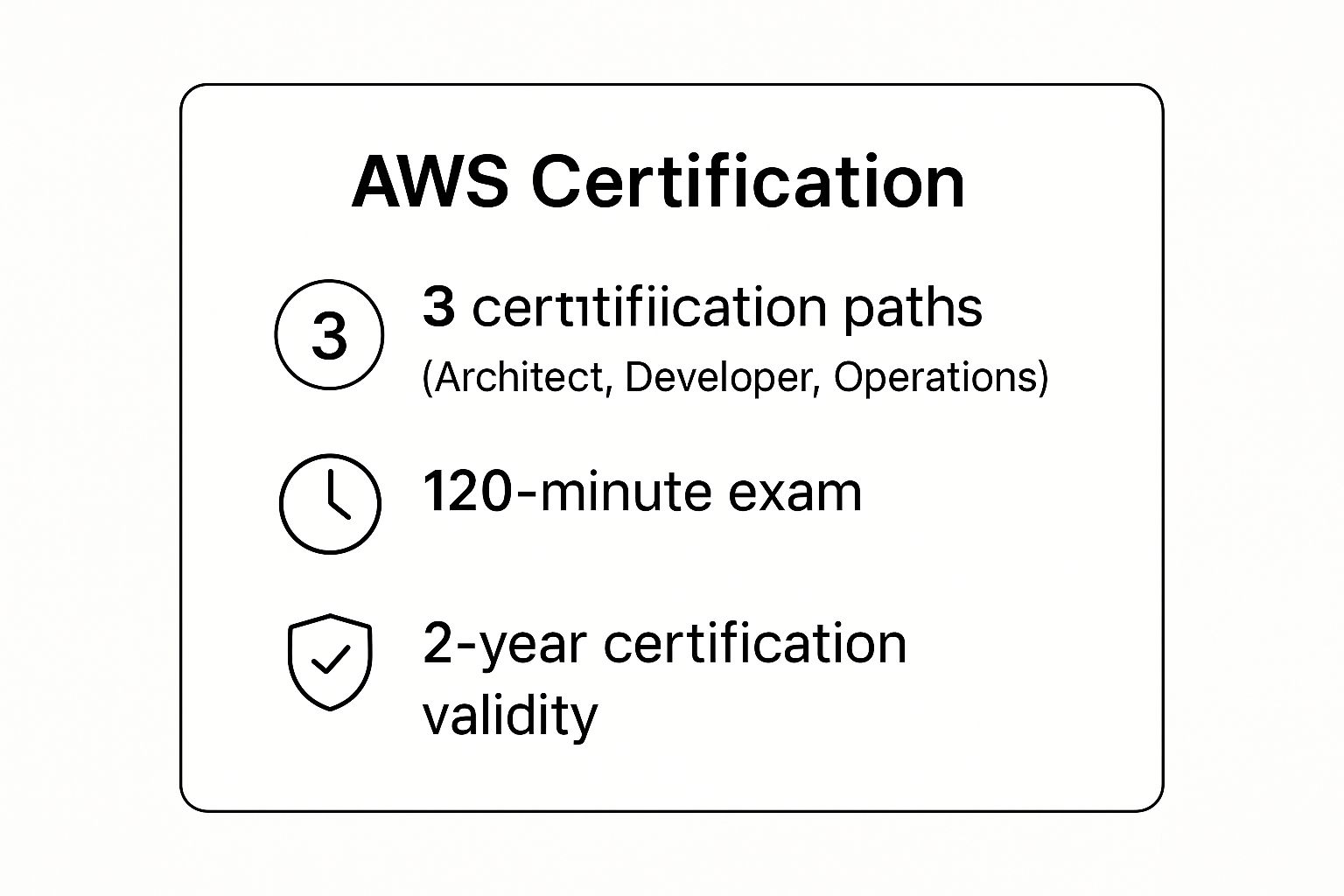
This infographic gives a handy visual summary of the key details for most Oracle Cloud exams.
 Image
Image
This visual gives you a high-level overview, highlighting the main certification tracks along with typical time commitments and validity periods. It's a great starting point.
A Closer Look at the Levels and Paths
Choosing a certification isn't just about your current role; it's about building a career. The different levels, Associate and Professional, give you a clear roadmap for growth, taking you from fundamental knowledge to expert-level skills.
The key is to match your immediate needs with your long-term ambitions. An Associate-level certification can open doors today, while a Professional-level credential solidifies your expertise for senior roles tomorrow.
To make this crystal clear, I've put together a table that compares the primary certification paths. It’s designed to help you quickly see where you fit based on your role and experience.
Oracle Cloud Certification Paths at a Glance
| Certification Level | Target Audience | Focus Area | Example Certifications |
|---|---|---|---|
| Infrastructure (IaaS) | Cloud Architects, SysAdmins, Network Engineers | Core compute, storage, networking, security, and designing resilient cloud architectures. | OCI Architect Associate, OCI Architect Professional |
| Developer | Software Developers, DevOps Engineers | Building and deploying cloud-native apps, using APIs, containers, and serverless functions. | OCI Cloud Native Developer Professional, OCI DevOps Professional |
| Data Management | Database Administrators, Data Engineers, Analysts | Managing Autonomous Database, migrating databases, and using data management services. | OCI Database Management Professional, OCI Data Science Professional |
| Applications (SaaS) | Functional Implementers, Business Analysts | Implementing and managing Oracle's cloud applications like ERP, HCM, and CX. | Oracle Fusion Cloud ERP Implementation Professional |
So, what does this table tell you? If your world revolves around infrastructure, the IaaS path is your destination. If you spend your days writing code that runs in the cloud, the Developer path is calling your name. For those who live and breathe data, the Data Management path is the obvious choice. The Applications path is more niche, tailored for professionals who implement and manage Oracle's specific software-as-a-service products.
By carefully thinking about your role and using this breakdown, you can confidently select the Oracle cloud computing certification that will give you the biggest career boost. This targeted approach ensures your study time is an investment, not an expense.
Your Proven Study Plan for Passing the Exam
 Image
Image
Let's be honest: you can't just wing an Oracle cloud computing certification exam and expect to pass. Success comes from a smart, structured approach that blends book knowledge with real-world, hands-on skill. This is the battle plan I've seen work time and time again, a focused, four-week schedule designed to get you exam-ready.
This timeline is built around a typical Associate-level exam, like the OCI Architect Associate. Feel free to stretch or compress it based on your own experience and how much time you can commit, but the core principles of consistent, focused effort are what matter.
Your Four-Week Study Blueprint
The secret to this plan is simple: each week has a distinct focus that builds directly on the last, combining theory with immediate practice.
-
Week 1: Laying the Foundation. Your first 7 days are all about the fundamentals. Get into the official Oracle University free courses and zero in on Identity and Access Management (IAM), Virtual Cloud Networks (VCN), and Compute instances. But here's the crucial part: as you learn about a service, you must immediately log in to your OCI Free Tier account and build it. Don't just watch the video on VCNs; create one, configure its subnets, and launch an E2 Micro instance inside it.
-
Week 2: Adding the Key Layers. With the basics down, you'll start adding the next essential services. This week, your attention shifts to Object Storage, Block Volume, and File Storage. From there, you'll dive into Oracle's database services, especially the Autonomous Database. Again, don't just read about it. Attach a block volume to the instance you already built. Spin up an Autonomous Database. Then, start exploring the monitoring and logging tools to see how OCI keeps tabs on all the resources you've just created.
This hands-on approach is not optional. Watching a video about VCNs is passive. Actually building one, complete with subnets and route tables, cements the concepts in your brain in a way that reading never could.
The real learning kicks in when you hit a wall. When a security rule is blocking your connection or an IAM policy isn't behaving as you expect, you’re forced to troubleshoot. That practical, problem-solving experience is what truly separates the people who pass from those who don't.
Weeks Three and Four: Sharpening Your Edge
Now that you understand the core components, the final two weeks are all about refining your knowledge, practicing under pressure, and building unshakeable confidence. You’re shifting from being a learner to being a test-taker.
Week 3: Practice Exams and Deep Dives
This week is dedicated to finding and fixing your weak spots. Start hammering high-quality practice exams from a platform like HydraNode. Don't obsess over getting a perfect score at first, the real gold is in the detailed explanations for every question you get wrong.
Are you consistently missing questions on networking? Spend a day re-reading the docs on VCN peering and transit routing. Getting tripped up by IAM policies? Head back to the console, write some more granular policies, and test them to see what happens.
Week 4: Final Review and Exam Simulation
This is the final sprint. Your efforts should be laser-focused on two key activities:
- Timed Practice Runs: Take at least two full-length practice tests under strict, timed conditions. This builds the mental stamina you need for the real thing and gets you comfortable with managing the clock.
- Active Recall Drills: Ditch the passive re-reading. Grab the official exam blueprint and, for each topic, try to explain it out loud or scribble down the key points from memory. This technique is far more powerful for long-term retention.
Want to Make It All Stick? Build a Mini-Project
If there’s one thing that will tie everything together, it’s building something tangible. It doesn't need to be some massive, enterprise-grade application. A simple two-tier web app is perfect.
- Web Tier: Set up a public subnet with a VM running a basic web server like Nginx.
- Database Tier: Create a private subnet holding an Autonomous Database.
This simple project forces you to connect every single dot: networking, firewalls, security rules, compute instances, and database services. When you're troubleshooting why your web server can't talk to the database, you'll learn more about security lists and route tables than any documentation could ever teach you.
This is how abstract concepts become practical, unforgettable skills, giving you the deep confidence you need to walk in and ace your Oracle cloud computing certification exam.
How to Register for Your Oracle Exam Without the Hassle
After weeks of hitting the books and mastering OCI services, the last thing you want is a clunky registration process to kill your momentum. Booking your exam can feel like a chore, but it's actually pretty simple once you understand the flow. I'll walk you through it so you can get it done and get back to studying.
The whole process is a tag team between your Oracle account and the Pearson VUE testing site. Think of your Oracle account as your home base and Pearson VUE as the venue that handles the actual test scheduling and delivery, whether you go to a test center or take it online.
Start with Your Oracle Account
Everything hinges on having a verified Oracle account. If you’ve been practicing with the OCI Free Tier, you’re already set. If not, go ahead and create one now, it’s your first real step. This account is your key to unlocking CertView, Oracle's dedicated certification portal.
Once your account is ready, make your way over to CertView. This dashboard is your command center for your entire Oracle cloud computing certification journey.
This is the CertView dashboard you'll see after logging in.
From here, you'll be able to track your exam history, check your scores, and, most importantly, download those hard-earned official certificates and digital badges once you pass.
Jump from CertView to Pearson VUE
Inside the CertView portal, you’ll see an option to schedule an exam. Clicking this link doesn't just take you to any site; it seamlessly authenticates you and transfers you directly to the Pearson VUE website, Oracle's official testing partner. This is where you’ll handle all the scheduling logistics.
Once on the Pearson VUE site, you'll need to:
- Pinpoint your exam: Search for the specific exam code you've been prepping for, like
1Z0-1072for the Architect Associate. - Decide on your testing environment: You have two choices, taking it at a local testing center or opting for an online proctored exam from home.
- Lock in your date and time: Look for a slot that works for you. Are you sharpest at 9 AM? Grab a morning slot. More of a night owl? Find something in the afternoon.
The online proctored option offers incredible flexibility, but don't take the requirements lightly. You need a completely private room, a rock-solid internet connection, and a webcam. Crucially, run the mandatory system test on the exact computer and network you’ll use for the exam. Do this a few days ahead of time, not an hour before. This one check can save you from a world of technical pain on exam day.
Finalizing Your Booking
The last piece of the puzzle is payment and confirmation. Most Associate and Professional exams run between $150 and $250. If you scored a voucher from an Oracle training event or promotion, this is the screen where you'll enter the code to waive the fee.
After you've paid and confirmed your spot, Pearson VUE will send you a confirmation email. Don't just archive it, read it. It has all the critical rules and instructions for the big day. Flag it, print it, do whatever you need to do to keep it handy.
And that’s it! With your exam officially booked, you can put the logistics behind you and refocus on that final stretch of preparation. To help sharpen your test-taking skills, check out our guide on how to prepare for any certification exam. Now you can walk into your test feeling prepared, not flustered.
Acing the Exam and What Comes After
The day of your Oracle cloud computing certification exam is the culmination of all your hard work. You’ve studied the materials, you’ve gotten your hands dirty in the labs, and now it's game time. Let's talk about how to navigate the exam itself and, just as importantly, what to do the moment you see that "PASS" on the screen.
Your strategy during the exam is just as important as the months you spent preparing. Once that timer starts, it becomes your main adversary. A smart time management plan is essential.
Navigating the Exam Interface
When the exam loads, take a deep breath. Don't just jump into the first question. Spend a solid 30 seconds getting your bearings. Find the timer, locate the "next" and "previous" buttons, and pay special attention to the "flag for review" feature. This little checkbox is your secret weapon.
I’ve found a two-pass approach works best for me and many others I’ve talked to.
- The First Pass (The Low-Hanging Fruit): Run through the entire exam, answering only the questions you know with absolute certainty. If a question gives you even a moment's pause, flag it and move on. The goal here is to bank as many easy points as possible and build momentum without getting bogged down.
- The Second Pass (The Deep Dive): After you've completed your first pass, you'll have a good portion of the exam done and a clear idea of how much time you have left. Now, circle back to your flagged questions. With the initial pressure off, you can dedicate focused brainpower to these more challenging problems.
What if you're completely stumped? It happens to everyone. Methodically eliminate the options you know are wrong. From there, make your most educated guess and keep moving. It's far better to make a smart guess than to leave an answer blank or waste five minutes on a single question.
Turning a Passing Score into Career Momentum
You did it! Seeing that "PASS" confirmation is an incredible feeling, but your work isn't quite done. The real power of a certification lies in how you leverage it. The first order of business is making it official.
Within a day or so, you'll receive an email from Oracle to claim your digital badge via CertView. This isn't just a formality, this badge is your verifiable proof of skill.
Your digital badge is so much more than a static image. It's a live credential that recruiters can click to verify its authenticity, instantly confirming the skills you’ve demonstrated. It’s your public, undeniable proof of expertise.
Once you’ve claimed your badge, it's time to put it to work for you.
Showcasing Your New Credential
Don't be shy about your achievement. Getting your certification in front of the right people is how you open doors to new opportunities. Here's your action plan:
- Update Your LinkedIn Profile: This is non-negotiable. Add your new credential to the "Licenses & Certifications" section. Recruiters live on LinkedIn and use keyword searches for specific certifications like this. Make sure you link it to Oracle as the issuing authority.
- Share Your Badge: Create a post on your LinkedIn feed announcing your accomplishment. Talk a little about the experience. For example, "Thrilled to have earned my OCI Architect Associate certification! The deep dive into VCNs, IAM, and architecting resilient cloud solutions was challenging but incredibly rewarding." This shows your network you’re committed to professional growth.
- Refresh Your Resume: Add the full, official certification title and the date you earned it. This small detail can be the very thing that gets your resume moved from the "maybe" pile to the "interview" pile.
When you get an interview, be ready to talk about your Oracle cloud computing certification with confidence. Don't just state that you have it; explain the story behind it. You could say, "I pursued the OCI Architect certification specifically to deepen my understanding of multi-region disaster recovery, as I know that's a critical requirement for enterprise-level projects." This turns a line-item on your resume into a compelling narrative about your dedication.
Finally, keep the momentum going. Technology moves fast. Use this win to plan your next one, whether that’s a Professional-level exam or specializing in a different area. To stay sharp and prepare for what's next, platforms like HydraNode for exam preparation offer practice for a wide range of exams, helping you get ready for the next challenge.
Common Questions About Oracle Certifications
 Image
Image
As you start piecing together your certification plan, you're bound to run into some practical questions. Figuring out the logistics, like cost, how long your cert stays valid, and what happens if you don't pass, is just as crucial as building your study schedule. Let’s clear up some of the most common questions I hear from candidates so you can get started with confidence.
How Much Does an Oracle Certification Really Cost?
You might be surprised to learn that getting an Oracle certification is often more affordable than you'd think. While costs differ depending on the specific exam, there’s a predictable pattern to the pricing.
Foundational exams, such as the OCI Foundations Associate, are often offered for free or at a pretty low cost, usually around $95. This makes it easy to get your foot in the door. As you climb the ladder to more advanced credentials, the price naturally goes up. You can expect Associate and Professional level exams to be in the $150 to $250 ballpark.
But here's a pro tip: always be on the lookout for Oracle's official promotions. I’ve seen programs like their "Race to Certification" offer free training and even free exam vouchers. Checking the Oracle University site regularly can save you a significant amount of money, sometimes all of it.
Do Oracle Certifications Expire?
Yes, and honestly, that's a good thing. Most OCI certifications are tied to specific platform versions and stay active for 18 to 24 months. This isn't just a way to get you to take more tests; it’s designed to make sure your skills are current and aligned with the newest OCI services.
In a field that moves as fast as cloud computing, a certification that lasts forever quickly becomes obsolete. The recertification process signals to employers that you’re committed to keeping your knowledge fresh and relevant.
Think of recertification as a periodic tune-up for your skills. It validates that you haven't just learned the material once but are keeping pace with Oracle's continuous innovation, which is a powerful signal to employers.
And don't worry, Oracle won't let it sneak up on you. Their CertView platform is your go-to spot for managing your credentials. You’ll get plenty of notifications well before your expiration date, giving you ample time to prepare for the required delta or recertification exam.
What Happens If I Fail an Oracle Exam?
Failing an exam is a bummer, but it's far from a dead end. In fact, it's a common part of the process for many of us. Oracle has a straightforward retake policy that gives you another shot.
If you don't pass the first time, you’ll need to wait 14 days before you can try again. This mandatory cool-down period is your chance to regroup, analyze what went wrong, and hit the books. You can attempt a specific exam up to four times within a 12-month window.
My advice? Treat a failed attempt like a diagnostic tool. Your score report breaks down your performance by topic, pinpointing exactly where you need to double down on your studying. That kind of targeted feedback is pure gold for your next try.
Can I Take My Oracle Exam from Home?
You absolutely can. Oracle partners with Pearson VUE to offer online proctored exams, which is a game-changer for convenience. You can test from your own home or office without the hassle of traveling to a testing center.
Of course, to maintain the integrity of the exam, there are some strict rules you'll need to follow:
- A Private Space: You must be alone in a quiet room where you won't be interrupted.
- A Stable Connection: A reliable internet connection is non-negotiable to prevent any technical glitches.
- System Integrity: You'll need a computer with a webcam and must run a system check on the Pearson VUE website before your exam day.
An online proctor will monitor your session through your webcam to ensure everything is above board. It's a secure and incredibly flexible way to earn your Oracle cloud computing certification on your schedule.
Ready to start your certification journey with confidence? HydraNode provides an AI-driven exam preparation platform that helps you study smarter. With practice tests tailored to your knowledge gaps and real-time analytics, you can master the concepts and walk into your exam fully prepared. Discover our plans at https://www.hydranode.ai.