
How to Train Employees: Proven Strategies for Success
Effective employee training isn't just about sharing information; it's about building a structured system that deliberately closes skill gaps and drives your business forward. This means moving past informal, on-the-fly instruction and committing to a program that builds real capability, keeps your best people around, and delivers results you can actually measure.
When you get it right, training stops being a line item on a budget and becomes a genuine strategic advantage.
Why You Can't Afford to Ignore Employee Training
In today's market, just hiring for the skills you need right now is a shortsighted strategy. The ground is constantly shifting, and the abilities that are critical today could be outdated tomorrow. If you're only ever reacting to your talent needs, you'll always be playing catch-up, scrambling for new hires in a cutthroat market while the potential within your own team goes untapped.
The real shift happens when you start seeing training as a core business function, not just an HR initiative. It's a direct investment in your company's stability, its capacity for innovation, and its long-term profitability.
The Skills Gap Is a Growth Killer
That gap between the skills your team has and the skills your business needs isn't a minor headache—it's a direct threat to your growth. When your people don't have the right competencies, projects slow down, new ideas dry up, and your competitive edge starts to fade. This isn't just a hunch; it's a well-documented global reality.
The World Economic Forum's Future of Jobs Report 2025 paints a stark picture, highlighting skill gaps as the single biggest barrier to business transformation. A massive 63% of employers pointed to skill deficiencies as a major roadblock to progress between 2025 and 2030. It's no surprise, then, that 85% of those same employers are planning to focus on upskilling their current workforce to get ahead of the problem.
Upskilling Is Your Best Defense Against Turnover
Recruiting is a grind. It’s expensive, it's time-consuming, and the constant cycle of hiring, onboarding, and then losing people creates a huge amount of instability and wasted resources. One of the most effective ways to break that cycle is with a strong internal training program.
When your employees see a clear path for advancement right where they are, their sense of loyalty and engagement goes through the roof.
Investing in your team's development sends a powerful message: "We value you, and we want you to succeed here." That's the kind of commitment that fosters a culture of loyalty that money alone can't buy.
This focus on internal growth makes your organization a more attractive place to work, helping you not only keep your top performers but also attract new ones. For technical teams, a platform like HydraNode can be a cornerstone of this strategy, providing a structured path to valuable vendor certifications that benefit both the employee and the company.
A systematic approach to training delivers clear, undeniable benefits:
- Improved Stability: You'll reduce turnover by showing employees you're invested in their careers, not just their current role.
- Boosted Profitability: A more skilled team is a more productive and efficient one. That flows directly to the bottom line.
- Future-Proofing Your Business: Proactively closing skill gaps means you can adapt to new technologies and market shifts without missing a beat.
Ultimately, knowing how to train your employees effectively is about building a resilient, adaptable, and highly skilled team from the inside out.
Building Your Strategic Training Blueprint
 Image
Image
Let's be honest: world-class training programs don't just happen. They don’t start with a simple course enrollment, either. They begin much earlier, with a strategic blueprint that ties every learning activity directly back to a real business outcome.
Without this foundational plan, even the best training efforts can fall flat, leading to wasted time and a frustrated team. This blueprint is your roadmap. It ensures your training plan is built on a rock-solid understanding of where your team is now, where the business needs them to be, and how specific skills will bridge that gap. This is how you shift training from a reactive checkbox item to a proactive strategy for growth.
Identify High-Impact Vendor Certifications
First things first, you need to move beyond generic training and zero in on the vendor certifications that will actually move the needle for your business. The goal here is to find that sweet spot where your company's strategic goals and your employees' career ambitions intersect.
Start by looking at the big picture. What are your business objectives for the next 12-18 months? Maybe you're migrating to a new cloud platform, trying to harden your cybersecurity posture, or rolling out new business intelligence tools. These initiatives are your North Star—they tell you exactly what kind of technical expertise you need to cultivate in-house.
For instance, if a major company initiative is to shift infrastructure over to AWS, it’s a no-brainer to prioritize certifications like the AWS Certified Solutions Architect or AWS Certified Developer. This is a perfect example of aligning training directly with a critical business need.
Then, go talk to your people. What certifications are they actually interested in pursuing? Tapping into their career aspirations builds motivation from the get-go. When someone sees that getting certified benefits their own professional growth as much as it does the company's bottom line, their commitment to the training process goes through the roof.
Conduct a Meaningful Skills Gap Analysis
Okay, so you've picked out your target certifications. Now you need a crystal-clear picture of your team’s current skill set. A skills gap analysis gives you this baseline, showing you precisely where your team stands and how far they have to go. Generic assessments won't do the trick here; you need data that's both specific and actionable.
I’ve found a three-pronged approach works best:
- Self-Assessments: Simply ask your team members to rate their own confidence and competence against the official objectives for a target certification. This gives you a great qualitative starting point.
- Manager Evaluations: Next, have direct managers provide their own take on each person's skills. This adds a crucial layer of perspective and helps validate the self-assessments.
- Baseline Testing: Finally, use a platform like HydraNode to generate a preliminary practice exam based on the target certification. The results from this give you unbiased, hard data on specific knowledge gaps.
This combined approach provides a truly comprehensive view. You might discover that while your team is solid on core cloud concepts, they're surprisingly weak when it comes to specific networking and security protocols. That’s gold. It’s exactly the kind of insight you need to tailor their learning paths effectively.
A proper skills gap analysis isn't about pointing out weaknesses. It's about creating a personalized starting line for every employee, ensuring the training they receive is relevant, challenging, and efficient.
Map Certifications to Roles and Career Paths
With target certifications identified and skill gaps measured, the final piece of the puzzle is connecting it all back to your organizational structure. This is where you formalize the "what's in it for me" for your employees, making the training program a tangible part of their career journey.
This is another area where a tool like HydraNode really shines. You can use it to map specific certifications to different job roles and seniority levels within your team. Think of it like building a career ladder.
For example, you could set up a clear progression:
- Junior IT Support: Must achieve the CompTIA A+ certification.
- Cloud Engineer: The next logical step is earning the Microsoft Certified: Azure Administrator Associate.
- Senior Security Analyst: The long-term goal is the prestigious (ISC)² CISSP certification.
Suddenly, you’ve created a transparent path for advancement. An employee can look at the map and see exactly what they need to learn to get to the next level, which turns a "job" into a "career" with a defined trajectory. That right there is a powerful, built-in motivator.
By taking the time to build this strategic blueprint before you launch anything, you guarantee your efforts are focused, your budget is well-spent, and your team is bought-in from day one. You’ll have a systematic approach that not only closes today’s skill gaps but also builds a more capable, loyal, and future-proof workforce.
Onboarding Your Team for Maximum Engagement
You've spent weeks, maybe even months, mapping out the perfect training blueprint. But here's a hard truth I've learned over the years: the best plan on paper will fall flat if the rollout feels like just another top-down corporate mandate. That initial onboarding experience is your one and only shot to make a great first impression. It's the moment that decides whether your team sees this as a genuine opportunity for growth or just more work piled onto their already full plate.
A messy or confusing launch can extinguish motivation before a single training module is even clicked. To really train your employees effectively, you have to handle this part with care, building genuine excitement and providing absolute clarity from day one.
Crafting the Kickoff Communication Plan
Let's talk about the announcement. Please, resist the temptation to just fire off a dry, formal email with a login link. That's a surefire way to get an eye-roll and a "do-I-have-to?" attitude. Instead, think of this as a mini-marketing campaign. Your goal is to build anticipation and directly answer the question every single employee is thinking: "What's in it for me?"
Frame this whole initiative around career growth and opportunity, not just checking a compliance box. You need to explain why the company is investing in these certifications and—this is the crucial part—how it directly benefits them. Talk about the in-demand skills they'll acquire, the new career paths it could unlock, and how it polishes their professional profile.
For instance, if you're rolling this out to an IT team for AWS certifications, you'd focus on the insane industry demand for those skills. For a sales team learning a new product, you’d hammer home how this training helps them smash their targets and close bigger deals.
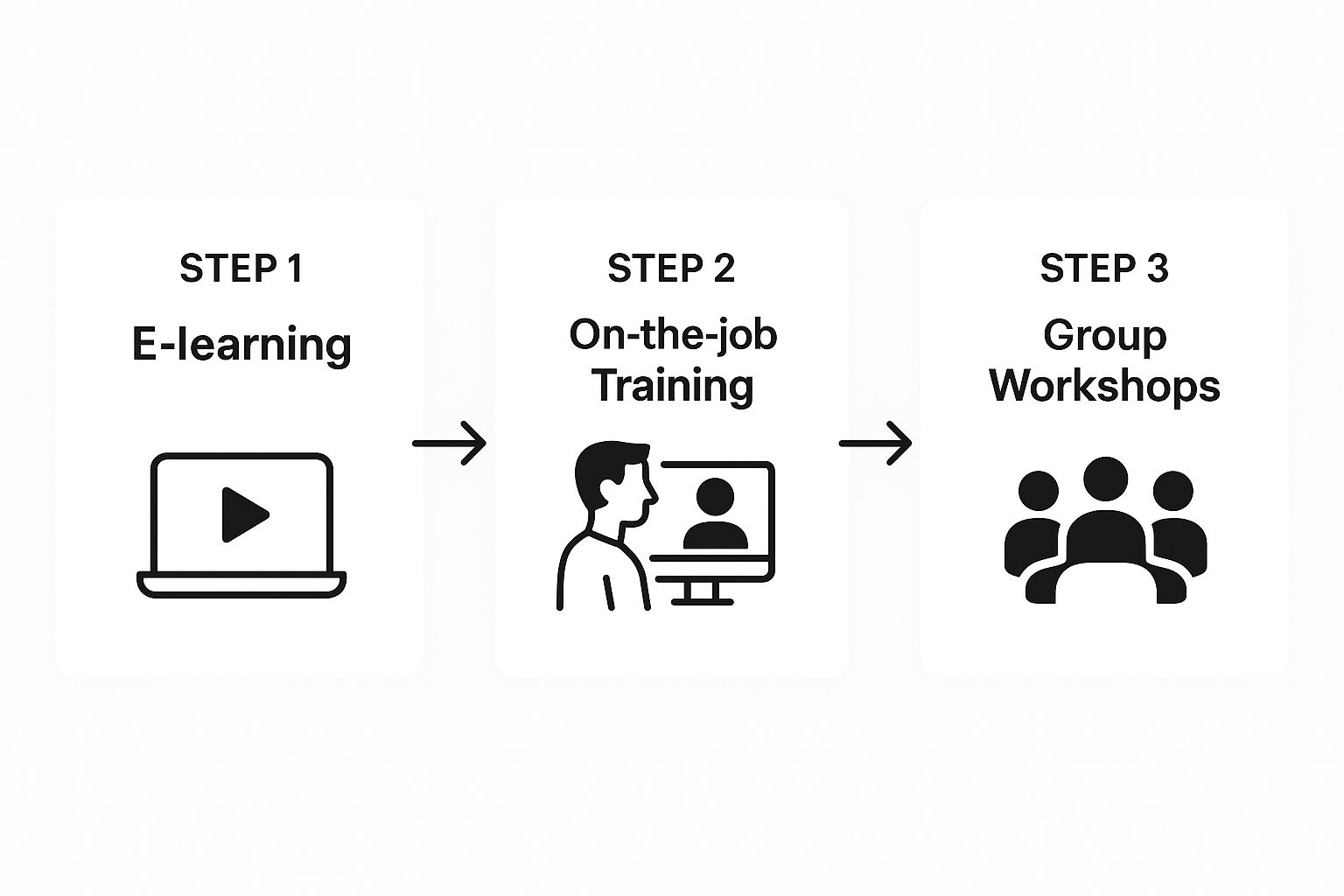
A blended approach to the training itself often lands best, catering to different learning styles. You can start with some self-paced e-learning, then reinforce it with real-world application on the job, and cap it off with collaborative workshops. This creates a much richer, more effective learning cycle.
 Image
Image
Personalizing the Initial Experience
One-size-fits-all training is a recipe for disengagement. When an employee logs into a platform like HydraNode for the first time, their dashboard should feel like it was built specifically for them. This is where your skills gap analysis becomes your best friend—use that data to pre-assign the most relevant certification path and the right starting modules for each person.
This simple act of personalization immediately shows you respect their time and understand their unique starting line. It stops your senior folks from getting bored with basic content and prevents junior employees from feeling completely overwhelmed by topics way over their heads.
A critical mistake I see managers make is throwing the entire feature set at their team on day one. A gradual introduction is essential. Start by showing them the absolute must-knows: how to find their assigned courses, launch a practice test, and check their progress. Overloading them with bells and whistles is the fastest way to cause confusion and frustration.
A great first experience sends ripples far beyond the training program. It turns out that structured, thoughtful onboarding is directly tied to better retention and engagement. In fact, organizations with solid onboarding programs can boost new hire retention by an impressive 82%. It just goes to show that the care you put into how you train employees from the beginning pays off in the long run. If you're curious, you can dig into more employee training statistics to see the full picture.
Sample Onboarding Checklist for HydraNode
To keep things organized and ensure no one falls through the cracks, a simple checklist can be a lifesaver. Here’s a sample you can adapt for your own rollout.
| Phase | Task | Key Objective |
|---|---|---|
| Pre-Launch | Craft and schedule kickoff communications. | Build anticipation and clearly articulate the "What's In It For Me?" |
| Pre-Launch | Use skills gap data to create personalized learning paths. | Ensure each employee's first experience is relevant and not overwhelming. |
| Launch Day | Host a hands-on kickoff session (30-45 mins). | Walk the team through login, key features, and their first small task. |
| Week 1 | Assign the first module and set a clear completion goal. | Create immediate momentum and establish a learning rhythm. |
| Week 1 | Send a follow-up email with FAQs and support contacts. | Proactively address common questions and show a clear support path. |
| Week 2 | Check progress reports in HydraNode. | Identify anyone who is stuck or hasn't started and offer help. |
This checklist isn't just about ticking boxes; it's a framework for creating a supportive and structured environment right from the start.
Launching with a Hands-On Session
Finally, make sure you schedule a brief, mandatory kickoff session for each team. I'm not talking about a long, boring lecture. This needs to be a hands-on workshop. Your mission is to get everyone logged in and to have them complete one small, introductory task together—like their first practice quiz in HydraNode.
Use this live session to:
- Reinforce the "Why": Briefly hit on the program's goals and personal benefits one more time.
- Demo the Essentials: Physically show them how to navigate their dashboard and start their learning path.
- Field Questions: Tackle any confusion or technical hiccups right there on the spot.
- Set Clear Expectations: Talk about the expected pace, key milestones, and how you'll be supporting their progress.
An interactive session like this demystifies the platform and swaps any anxiety for confidence. By literally guiding them through their first few clicks, you build positive momentum that will propel them into their certification journey. This hands-on, supportive launch is one of the most important things to get right if you want to know how to train employees successfully.
Guiding Your Team to Certification Success
 Image
Image
Alright, you've kicked things off and your team is officially onboarded. Now the real work begins—and it's not about just assigning courses. Your role is shifting from announcer to coach. The day-to-day guidance you provide from here on out is what truly keeps the momentum going and turns study time into certified expertise.
This is where you'll monitor, motivate, and mentor your people. It means going beyond just checking boxes and really digging into how well they're grasping the material. This is where a tool like HydraNode really shines, giving you the insights you need to coach effectively, not just manage.
Look Beyond the Progress Bar
It’s easy to get fixated on that progress bar inching its way to 100%, but let’s be honest—that doesn't tell you the whole story. Real learning is messy, and just because a module is "complete" doesn't mean the knowledge has stuck. To effectively train your team for tough certifications, you need a much deeper look.
So, instead of just asking, "Are you done with that module yet?" try asking, "What was the trickiest concept for you in that section?" It’s a simple switch, but it opens up a conversation that reveals way more than a dashboard ever could.
The best way to gauge real understanding is to look at performance data from simulated labs and practice quizzes. These are designed to mimic the pressure and format of the actual exam, giving you a far more accurate picture of who’s ready and who needs a bit more support.
Using Analytics to Be a Better Coach
Your analytics dashboard is your secret weapon for coaching. It’s how you spot the two types of employees who need your attention most: the ones who are soaring and the ones who are silently struggling. You can't afford to ignore either.
Start by looking for patterns in the data:
- Your High-Fliers: Find the people who are consistently acing the practice exams. These aren’t just star students; they’re your potential team mentors. Give them a public shout-out and ask if they’d be willing to lead a quick study session on a topic they’ve clearly mastered.
- The Quietly Struggling: Look for folks who keep getting stuck on the same topics in quizzes. This isn’t a red flag for failure; it’s a signal for you to step in. A quick, private "Hey, I noticed you're finding the network security section tough. How can I help?" can make a world of difference.
For example, if you see someone repeatedly fumbling questions on network protocols, you can do more than just offer encouragement. You can send them a direct link to a targeted resource, like the CompTIA Network+ practice exam questions, to help them drill down on that specific area. This kind of targeted help is infinitely more useful.
Your job as a coach isn't just to watch the numbers. It's to clear the path. Use the data to start conversations, offer specific help, and turn stumbling blocks into learning opportunities.
Build a Culture Where Your Team Learns Together
While individual study time is crucial, some of the best learning happens when people collaborate. Your final, and perhaps most important, task is to build a culture where your team helps each other succeed. This transforms studying from a solo grind into a shared mission.
Set up a dedicated chat channel for the training program, or encourage everyone to use the platform’s social features. This gives employees a safe space to ask questions, share killer study tips, and celebrate the small wins along the way.
I've seen teams have great success with "Study Pods." Just group three or four employees working toward the same certification. This creates natural accountability and peer support. When one person finally cracks a tough concept, they can explain it to the others—which, by the way, is one of the best ways to solidify your own knowledge.
This approach pays off big time. A study from the Association for Talent Development found that a staggering 88% of employees believe social learning is important for their growth. By building this kind of supportive environment, you're not just boosting pass rates—you're strengthening your team's foundation for the long haul.
Keeping the Fire Lit for the Long Haul
Getting a new training program off the ground is one thing. There's a natural buzz of excitement, a sense of new beginnings. But what happens a month in? That's the real test. Keeping that energy alive when the novelty wears off is what separates a program that delivers real, lasting value from one that just fizzles out.
This is where the real work begins. We're moving beyond a one-off training event and building a genuine culture of continuous learning. It’s about weaving professional growth into the daily fabric of your team, not just treating it as a project with a start and end date. This requires a shift from simple management to smart motivation, using clever tactics to keep your team focused, engaged, and even a little competitive.
Stoke the Flames with Friendly Competition
Let's be honest—nothing gets people moving like a bit of friendly rivalry. This is where gamification, when done thoughtfully, can be a game-changer. I’m not talking about turning your office into an arcade. It’s about using proven game mechanics to make the often-grueling process of studying for a certification more engaging.
HydraNode is built for this. You can easily set up leaderboards showing who's crushing the practice exams or who has burned through the most modules that week. It’s a simple feature, but that visibility taps right into our natural drive to compete and improve.
You can also create custom achievement badges to mark key milestones. Think about things like:
- Quick Starter: Awarded to anyone who knocks out the first module within 48 hours.
- Exam Ace: For team members who score over 90% on a full-length practice test.
- Topic Master: Unlocked when someone finally nails all the questions for a notoriously tricky certification topic.
These aren't just for fun. Badges and leaderboards provide instant, tangible proof that the hard work is paying off. They create a series of small wins that keep morale from flagging on the long road to a full certification.
Celebrate Every Step, Not Just the Finish Line
Never, ever underestimate the power of a well-timed "great job." When someone is grinding through dense technical material for a vendor cert, burnout is a real threat. If you only wait to celebrate when they have the final certificate in hand, you’re missing countless opportunities to keep them going.
Make it a habit to call out the small wins. Did someone finally conquer a module they’d been stuck on for a week? Mention it in your next team huddle. Did a study group all pass a major practice exam together? Give them a public shout-out on Slack or Teams.
The trick is to be specific and timely. A generic "good job, everyone" is fine, but it doesn't land with nearly the same impact as, "Major kudos to Sarah for acing the security module—I know that one was a beast!" It shows you're actually paying attention.
This constant loop of recognition does more than just boost egos. It reinforces the message that this training matters and that their effort is seen and valued. When people feel appreciated, they stay in the game.
And staying in the game has a massive impact that goes far beyond new skills. Companies with highly engaged employees see some staggering results: a 78% drop in absenteeism, a 51% reduction in turnover, and a 23% increase in profitability. These numbers prove that when you keep your team motivated, the benefits are felt across the entire business. You can dig into more data on how engaged employees impact operational metrics to see the full picture.
By making gamification and consistent recognition part of your regular routine, you build a program that lasts. The initial enthusiasm doesn't just fade away—it matures into a deep, profitable, and self-sustaining culture of professional growth.
Common Questions About Employee Training Programs
 Image
Image
Even with a perfectly crafted plan, you're bound to run into questions and a few challenges when you roll out a new training initiative. That’s just part of the process. As a manager, thinking ahead about these common hurdles is the key to keeping your program on track and proving its value in the long run.
When you anticipate these questions, you can respond with clear, confident answers that build trust and address concerns before they ever become real roadblocks. Let’s walk through some of the questions I hear most often from other managers.
How Can I Convince Leadership to Invest?
To get the green light from leadership, you have to speak their language: return on investment (ROI). Stop talking about training as a cost. Instead, start framing it as a strategic move that solves real business problems.
Build a business case that directly connects a platform like HydraNode to measurable financial gains. For example, show them how upskilling your current team is far cheaper than paying hefty recruitment fees for new talent. You can use powerful stats to back this up, like the fact that strong onboarding can boost new hire retention by 82%. This isn't just a "nice-to-have"; it's a direct countermeasure to the high cost of employee churn.
You can also position this training program as the solution to the skills gap—something 63% of employers see as a significant threat to their business. When you frame it this way, you’re not asking for a budget for a perk. You're requesting resources for a direct investment in your company's productivity, stability, and future growth.
What Is the Best Way to Handle a Resistant Employee?
From my experience, resistance to training usually comes from two places. Either the employee thinks the training is irrelevant to their actual job, or they see it as just one more thing piled onto an already overflowing workload. The key is to get right to the heart of it and answer the "What's in it for me?" question.
Have a genuine one-on-one conversation. Don't just tell them; show them. Map out exactly how this specific certification will sharpen their skills, open doors for career growth inside the company, and make them a more valuable professional overall.
When an employee feels that training is being done to them, resistance is natural. When they feel they are an active participant in their own growth, their mindset shifts entirely. Involving them in choosing their certification path can be a powerful motivator.
Use a tool like HydraNode to create a personalized learning path that actually fits into their week, showing that you respect their time. And don't forget to celebrate the small wins publicly—like when they ace a tough practice quiz. It builds confidence and momentum. If they're stuck on a particular concept, you can guide them to specific resources, like a targeted HydraNode practice exam, to help them push past that one hurdle.
How Do We Measure the Real Impact?
Measuring the success of your training program goes way beyond just checking who completed a course. The real impact shows up in how skills are applied on the job and in tangible business results. You need to track metrics that draw a straight line from the training to team performance.
To get the full picture, I recommend focusing on three key areas:
- Skill Application: Use pre- and post-training assessments to get hard data on knowledge gain. This is where a platform like HydraNode really shines, giving you clear analytics on how much your team has improved.
- Business Metrics: Look at the key performance indicators (KPIs) that matter. For a newly certified security team, you'd want to see a drop in security incidents. For a sales team, you might track a higher close rate on a new product line.
- Employee Growth: Keep an eye on the internal promotion rate of employees who complete certifications. You can also use simple pulse surveys to see how their confidence and job satisfaction have changed after the training.
When you track these kinds of outcomes, you’re not just proving that people learned something. You’re showing that you're building a more capable, confident, and effective workforce that drives the entire business forward.