
How to Improve Reading Comprehension for Better Scores
When it comes to prepping for an IT certification, we often focus on labs, flashcards, and practice exams. But what if I told you the single most powerful, and often overlooked, skill is your reading comprehension?
To really crush these exams, you have to move beyond just letting your eyes scan the page. It's time to shift from passive reading to active engagement. This is about wrestling with the text—questioning it, putting complex ideas into your own words, and connecting the dots with what you already know. It's a game-changer, especially when you're staring down a dense technical manual.
Why Reading Comprehension Is Your IT Certification Secret Weapon
Let’s be real for a moment. The official guides from CompTIA, Cisco, or AWS aren't exactly beach reads. They're dense by design, loaded with intricate terminology, complex diagrams, and tricky scenarios. These books are built to test your understanding, not just your ability to recall facts.
This is exactly why strong reading comprehension is your secret weapon. It's the difference between seeing a firewall configuration and truly understanding the why behind each rule.
When you learn to actively engage with the material, you’re not just studying anymore—you’re building a deep, practical knowledge base. This means less time getting stuck rereading the same chapter five times and more time actually making progress. That confidence you build is what you’ll carry with you into the testing center, leaving exam-day anxiety behind.
Decoding Technical Language
Most people who fail a certification exam don't fail because they didn't study. They fail because they misunderstood the question. A single word can change everything. Think about the difference between "configure" and "troubleshoot"—a sharp reader spots that nuance instantly and knows exactly what the question is really asking.
Your goal is to build a mental framework that lets you:
- Pinpoint Core Concepts: Instantly spot the main point in a paragraph, even when it’s wrapped in layers of jargon.
- Connect the Dots: See how a specific subnetting rule in Chapter 3 directly impacts the network security protocols discussed in Chapter 8.
- Read Between the Lines: Figure out the implications of a scenario question when the perfect answer isn't spelled out for you.
The real leap happens when you move from rote memorization to genuine understanding. That’s what separates the first-time passers from those who end up rebooking their exam. This is the edge that elite reading comprehension gives you.
To illustrate how these skills directly translate to success on exam day, it’s helpful to break them down. Think of them as the foundational building blocks for decoding any technical challenge you'll face.
Core Comprehension Skills for IT Exam Success
| Essential Skill | Description | IT Exam Application |
|---|---|---|
| Active Skimming | Quickly scanning text to identify main ideas, keywords, and overall structure before a deep dive. | Reviewing a long scenario question to grasp the context (e.g., network size, security issue) before analyzing the details. |
| Contextual Vocabulary | Defining unfamiliar terms based on the surrounding sentences and your existing technical knowledge. | Deducing the meaning of a proprietary technology's name based on how it's used in a sentence about cloud services. |
| Identifying Nuance | Spotting subtle but critical differences in wording, such as "must" vs. "should" or "all" vs. "some." | A question asks for the most cost-effective solution, not just any solution that works. |
| Synthesizing Ideas | Combining information from different parts of the text (or different chapters) to form a complete picture. | Answering a question that requires you to apply knowledge of both routing protocols and firewall ACLs to solve a problem. |
Mastering these skills isn't just about passing an exam; it's about becoming a more competent and confident IT professional.
This focus on reading has become more important than ever. The pandemic had a noticeable impact on reading proficiency globally. A 2021 study revealed a significant jump in the number of children falling below basic proficiency levels compared to just 2016. You can dig into the detailed PIRLS data to see how reading trends have shifted worldwide. It’s a clear signal that many of us need to be more intentional about honing how we process and understand what we read.
Ultimately, turning passive reading into an active, strategic advantage is the bedrock of your certification journey. You'll learn faster, remember more, and walk into that exam ready for whatever they throw at you.
For those looking to put these skills into practice with AI-powered, adaptive testing, you can check out the HydraNode pricing plans.
Building Your Foundational Reading Habits
 Image
Image
Let's be real. You don't build rock-solid reading comprehension by pulling all-nighters. It's a skill forged in small, daily commitments that compound over time. Trying to cram an entire chapter on cloud networking after a draining workday? That’s just a recipe for frustration and forgetting everything by morning.
The first, most crucial move is to build a routine you can actually stick with. It all comes down to consistency. I’ve seen it time and again, and the research backs it up: there’s a direct line connecting how much you read to how well you understand. One fascinating study I came across showed that adding just six minutes of reading a day could literally double a person’s reading performance. You can check out the full research on how reading volume impacts skill.
This isn't about cramming; it's about habit-building. By setting aside just 20-30 minutes for focused reading every single day, you’re training your brain to tackle dense technical material without getting overwhelmed. It’s far more powerful than a frantic, multi-hour study binge once a week.
Create a Distraction-Free Zone
Your environment is everything. Trying to study for your AWS cert with your phone buzzing every two minutes and the TV blaring in the background is a losing battle. You have to carve out a space that tells your brain, "Okay, it's time to focus."
This doesn't mean you need a soundproof bunker. It's simpler than that:
- Toss your phone in another room or flip on "Do Not Disturb." Seriously.
- Grab some noise-canceling headphones to drown out the chaos.
- Find a specific chair or corner of a room that becomes your dedicated study spot.
This physical ritual helps minimize context-switching. When you sit in that "study chair," your brain already knows what's coming, making it so much easier to get in the zone.
The goal here is simple: reduce the friction between you and the text. Every notification you have to ignore, every conversation you tune out—it all saps a little bit of the mental energy you need to decode a complex technical concept.
Master the Art of Active Reading
If there's one core skill for improving comprehension, especially with dense IT topics, it's active reading. This is where you stop being a passive observer and start having a conversation with the material.
Think about it. You're reading a chapter on networking protocols. A passive reader just scans the definitions. An active reader, on the other hand, is asking questions:
- "How is this different from that other protocol I just read about?"
- "What's a real-world situation where this thing would completely fail?"
- "Can I boil this entire section down to one simple sentence?"
For example, when you're digging into a cloud security guide, don't just read about Identity and Access Management (IAM) policies. Stop and challenge yourself: "If I actually applied this policy right now, who specifically gets in, and who gets blocked?" This constant questioning is what turns abstract concepts into the kind of concrete, applicable knowledge that gets you points on exam day.
Advanced Strategies for Tackling Dense Technical Texts
 Image
Image
Alright, you've got the basic reading habits down. Now it's time to shift gears and get into the really tough stuff—the dense, jargon-filled chapters that can make your eyes glaze over. This is where we move past simple active reading and bring out the specialized tools.
I’m a huge fan of a classic academic technique I've adapted for IT pros: the SQ3R method. It stands for Survey, Question, Read, Recite, and Review. Think of it as a structured game plan for dissecting complex topics, like the intricate routing protocols or cryptographic standards you'll find in your certification guides. It forces you to engage with the material from different angles, which is exactly what you need when concepts build on one another.
Survey and Question: Your Pre-Flight Checklist
Before you plunge into a new chapter—let's say it's on advanced firewall configurations—stop. Don't just start on page one. First, survey the territory. Take two minutes and just skim. Look at the headings, subheadings, charts, and any call-out boxes. Get a feel for the lay of the land. This builds a mental roadmap before you ever start the journey.
Next, turn those headings into questions. If a section is called “Stateful Packet Inspection,” you immediately ask yourself, "Okay, what is stateful packet inspection? How is it different from the stateless stuff I already know?" This little trick completely changes the dynamic. You're no longer a passive sponge; you're on a mission, actively hunting for answers.
This prep work is incredibly powerful. It accomplishes two things:
- It creates context. You see the big picture before getting bogged down in the minutiae.
- It triggers curiosity. You're now part of an investigation, which is way more engaging than just plowing through text.
The point is to turn your study session from a one-way lecture into a two-way conversation. You're not just listening to the book; you're actively grilling it for the information you need.
Read with Purpose, Then Recite to Solidify
Now, you can finally read. But this time, it’s different. With your questions guiding you, your reading is targeted and efficient. When you find an answer, highlight it. Make a quick note in the margin. I find that diagrams and tables in technical manuals are goldmines—they often explain a process more clearly than five paragraphs of dense text.
But here’s the step most people skip, and it's the most critical: recite. After you finish a section, put the book down. Seriously. Now, try to explain the concept out loud, using your own words. If you can’t do it without stumbling, you don’t really get it yet. This isn't about rote memorization; it's about making the idea your own. For instance, after reading about RAID levels, you should be able to explain the trade-offs between RAID 5 and RAID 6 to a coworker without peeking at your notes.
This is what locks in the knowledge. The final piece, review, is just about revisiting your notes and summaries over the next few days to keep it fresh.
Once you've put these methods into practice, you can really put your understanding to the test. Head over to the HydraNode exam platform and generate a custom practice test on a specific topic. See if you can handle the kind of nuanced questions our AI can create—it's the perfect way to see if you've truly mastered the material.
Putting AI to Work for Personalized Practice
Old-school study methods definitely have their place, but if you want a real advantage, modern tools are where it's at. AI-driven platforms are completely changing the game for text-heavy certification exams. Think beyond just running through the same generic mock tests over and over. These tools are more like a personal diagnostic engine for your brain.
They analyze your performance with a level of detail that’s almost impossible to achieve on your own. Imagine a practice test that doesn’t just spit out a final score. Instead, it digs into how you answer. It can pinpoint if your mistakes stem from misreading the actual question, failing to pull key details from a long scenario, or struggling with questions that demand logical inference. That’s the secret to truly focused studying.
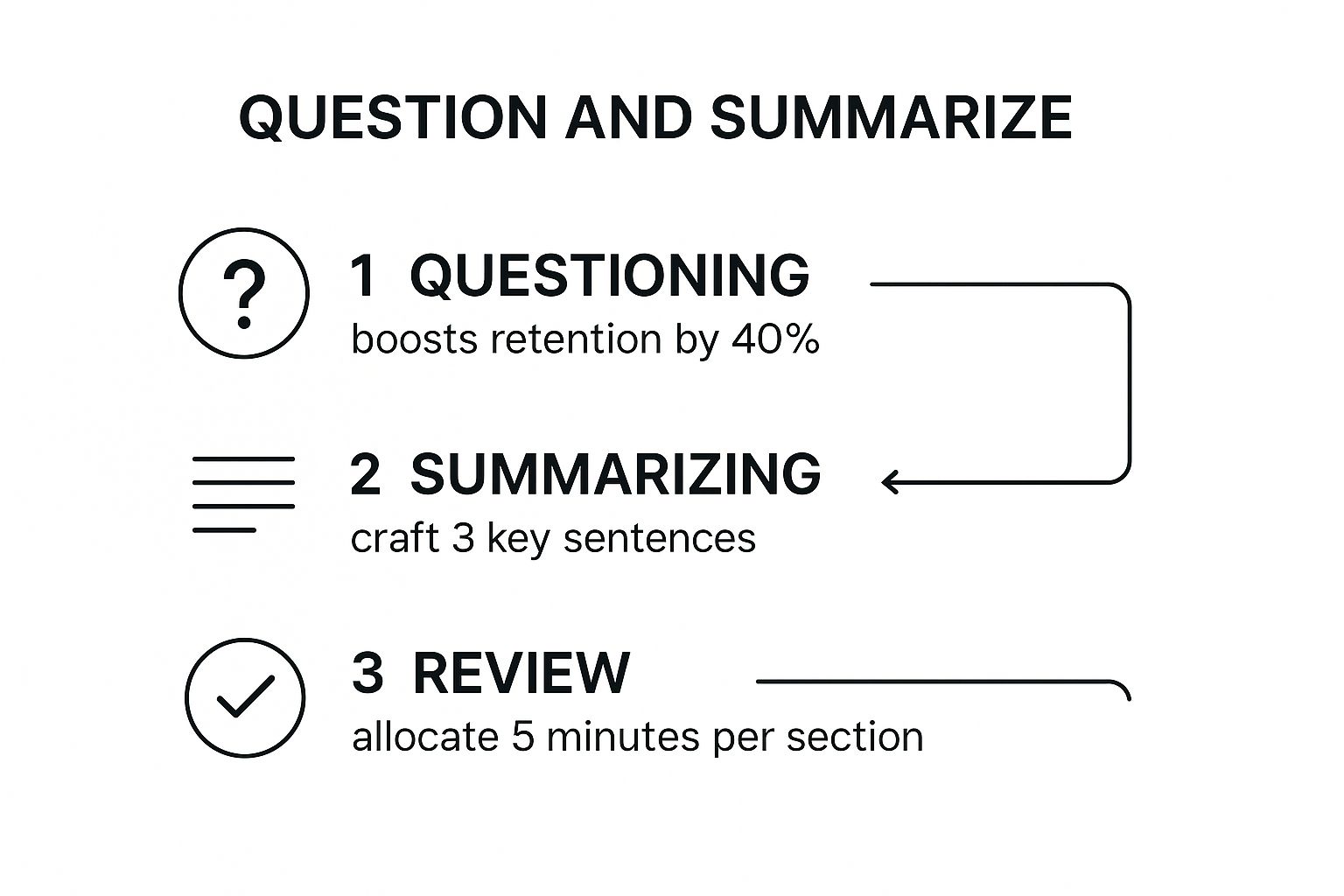
This core loop of questioning, summarizing, and reviewing is a powerful framework for your study sessions, designed to make information stick.
 Image
Image
This process shows how even small, structured actions—like just taking a few minutes to question what you've read and then summarize it—can have a huge impact on how well you actually learn and remember complex topics.
From Diagnosis to Targeted Drills
Here’s where it gets good. Once the AI figures out your specific comprehension gaps, it doesn't just give you a report and wish you luck. It builds personalized practice sets designed to hammer on those weak spots. This is a massive shift from traditional study methods.
Let's say your first diagnostic test shows you consistently miss questions that ask you to compare two very similar cloud services. What happens next is key:
- You aren't just told, "You're bad at comparing cloud services."
- Instead, the system generates a custom-built quiz full of scenarios that force you to tell those services apart, again and again, until it becomes second nature.
This approach turns your study time into a high-intensity workout for your brain. You’re strengthening the exact mental muscles that need it most.
Instead of rereading an entire chapter and just hoping you absorb what you missed the first time, you're doing focused, targeted reps on your weakest skills. This saves an incredible amount of time and builds the specific abilities you need to pass.
See the Feedback Loop in Action
The real magic happens when you see how this continuous feedback loop works. You start with a baseline assessment that shows you exactly where you stand, no guesswork involved.
Platforms like HydraNode offer AI-driven practice tests with detailed analytics that break down your performance. They pinpoint the exact question types and topics where your comprehension is shaky.
Suddenly, you're no longer staring at a mountain of documentation wondering what to study next. The data gives you a clear, actionable plan. It’s the classic difference between working harder and working smarter.
Measuring Your Progress and Refining Your Approach
 Image
Image
So, how do you know if all this effort is actually paying off? Sure, your practice test scores might be inching up, but that’s only one piece of the puzzle. Real, lasting progress comes from digging deeper—from honestly assessing how you learn and tweaking your strategy based on what you find.
It’s about moving beyond a simple right-or-wrong mindset. You have to put on your detective hat and diagnose the why behind every single mistake. This is the shift that separates guessing from genuine understanding and allows you to improve your reading comprehension in a truly targeted way.
Go Beyond the Score with the Feynman Technique
One of the most effective gut-checks for your understanding is the Feynman Technique. It’s brilliantly simple. Take any complex IT concept you're studying and try explaining it in the plainest language possible, as if you were talking to a friend who knows nothing about tech.
Let’s say you just read a dense chapter on Virtual Private Networks (VPNs). Before you close the book, grab a blank piece of paper. Now, try to explain how a VPN tunnel actually works without leaning on heavy jargon.
If you find yourself stumbling, getting stuck, or realizing you can only use the textbook's exact phrasing, that's a huge red flag. It means you haven't truly internalized the concept. This method is incredibly powerful because it exposes weak spots far more effectively than any multiple-choice question ever could.
This skill—distilling complexity into simplicity—is a universal sign of true comprehension. It’s no different in the broader world of reading, where the ability to interpret and explain what you've read is a key benchmark.
Analyze Your Mistakes with Precision
When you review your HydraNode practice exams, don't just glance at the correct answer and move on. That's a missed opportunity. Instead, you need to perform a post-mortem on every single question you got wrong.
Ask yourself a few diagnostic questions to pinpoint the real reason for the error.
- Comprehension Error? Did I just flat-out misread the question or misunderstand what it was asking for?
- Knowledge Gap? Was this a case of simply not knowing a specific technical detail or definition?
- Vocabulary Issue? Did an unfamiliar term throw me off and make the whole scenario confusing?
- Synthesis Failure? Did I know the individual pieces of information but fail to connect them to solve the problem?
When you start categorizing your mistakes this way, they stop being failures and become incredibly valuable data. This data tells you exactly what to work on next.
This systematic review lets you fine-tune your study plan on the fly. You're no longer just studying harder; you're studying smarter. If you're curious about the people who build tools designed for this kind of deep analysis, you can learn more about the mission behind HydraNode.
Walking into your exam with this kind of self-awareness is a game-changer. It’s what turns an anxious test-taker into a confident, certified professional.
Got Questions? I've Got Answers
When you're staring down the barrel of a tough IT certification exam, a lot of questions pop up about how to actually prepare. Let's tackle some of the most common ones I hear from people trying to boost their reading comprehension for these high-stakes tests.
My aim here is to give you straightforward, practical answers that get right to the heart of the challenges you're facing.
How Much Time Should I Really Be Reading Every Day?
This is the big one, isn't it? Everyone wants to know the magic number. But the truth is, it's not about logging punishing, multi-hour study marathons. Consistency is so much more powerful than intensity.
I tell everyone to aim for 20 to 30 minutes of focused, totally uninterrupted reading of technical material. Every single day. This isn't just about covering ground; it's about building a rock-solid habit. That short, daily session does wonders for retention and comprehension—way more than a frantic, four-hour cram session on a Sunday afternoon.
What's the Best Way to Deal With Jargon I Don't Know?
Hitting a wall of technical jargon can feel like the exam is already trying to fail you. It's frustrating. The absolute worst thing you can do is just skip over a term you don't recognize. Instead, treat each new word like a small puzzle to solve.
Don't just Google it and move on. Try this approach:
- Play Detective: Before you look it up, read the sentences around the term. Can the context give you any clues about what it might mean?
- Define It Yourself: Once you've found the official definition, put it into your own words. How would you explain it to a colleague?
- Build a Bridge: Connect the new term to a concept you already get. For example, "Ah, so this new protocol is just a more secure version of that other one I already know."
This active process transforms vocabulary from a roadblock into a real asset. You're not just memorizing words—you're weaving them into what you already know. That’s a skill that pays off big time when you're faced with complex scenario questions on the exam.
Is Speed Reading a Good Idea for IT Exams?
Let me be blunt: absolutely not. I see this advice floating around, and for technical exams, it's a recipe for disaster.
Speed reading is all about skimming for the gist of a text. That’s the exact opposite of what you need for an IT certification. Your goal isn't speed; it's depth and accuracy. You have to slow down, question what you're reading, and make sure you understand every detail and nuance.
Think about it. A single word like "except," "not," or "least" can completely flip the meaning of a question and send you straight to the wrong answer. Careful, deliberate reading is what gets you a passing score.
Ready to see if these strategies are working? The only way to know for sure is to put your comprehension to the test. HydraNode’s AI-driven platform creates practice exams that are tailored to you, showing you exactly where you need to focus. It's about studying smarter, not just longer. Explore HydraNode today and feel the difference.
