
Pass Your Microsoft Certification Exam Prep Guide
Passing a Microsoft certification exam isn't just about cramming information. It's about having a solid game plan that mixes a real-world understanding of the exam topics with a ton of hands-on practice. You need a study plan that works for you, active learning that sticks, and a smart way to use practice exams to find your weak spots and build up that exam-day confidence.
Why Microsoft Certifications Are a Career Game Changer
 Image
Before we get into the nitty-gritty of how to prep, let's talk about the why. In today's crowded tech scene, a Microsoft certification is way more than just another bullet point on your LinkedIn profile. It's a stamp of approval, a signal to hiring managers that you have proven, marketable skills in areas that businesses desperately need.
Image
Before we get into the nitty-gritty of how to prep, let's talk about the why. In today's crowded tech scene, a Microsoft certification is way more than just another bullet point on your LinkedIn profile. It's a stamp of approval, a signal to hiring managers that you have proven, marketable skills in areas that businesses desperately need.
Think of it this way: you're making a direct investment in your own career. When you earn that credential, you're showing you’re not just technically sharp, but you're also dedicated to keeping your skills fresh. It proves you can step in and solve real problems using Microsoft's tech stack.
Unlocking Real Career Benefits
The perks of holding a Microsoft certification go way beyond just looking good on paper. It actively opens doors to opportunities that can seriously level up your career path. I’ve seen it time and time again—certified folks just have an edge.
Here’s what that looks like in practice:
- Higher Earning Potential: Certified pros consistently earn more than their non-certified colleagues. It’s a fact.
- Better Job Prospects: Companies are actively headhunting candidates with certs for cloud, security, and data roles.
- Verified Skills: It’s concrete proof you can do what you say you can do, which builds instant trust with managers.
- Career Growth: That certification can be the very thing that gets you a promotion or helps you pivot into a more specialized role.
This isn't about passing one test and calling it a day. It's about laying the groundwork for a successful, long-term career. For instance, starting with the Azure Fundamentals AZ-900 exam is an amazing launchpad into cloud computing, a field that's absolutely booming.
A certification shows you’re committed, current, and capable. It tells employers you’re not just clicking around in dashboards; you understand the logic, the flow, and the strategy behind the technology.
Staying Ahead in a Fast-Moving Industry
The need for skilled IT professionals isn't going anywhere. The tech industry keeps growing, which means there’s a constant hunger for people who know how to manage and innovate with modern tools. Microsoft certifications are so valuable because they map directly to the technologies businesses rely on every single day.
The U.S. Bureau of Labor Statistics projects that jobs in computer and IT will grow much faster than the average for all other occupations between 2023 and 2033. This directly feeds the demand for people skilled in the Microsoft ecosystem—from Azure and Dynamics 365 to Power Platform and Microsoft 365.
Earning a certification makes sure your skills are not just up-to-date but perfectly aligned with what companies need right now. That makes all your microsoft certification exam prep a seriously smart move. You can find more insights on the value of Microsoft credentials from industry experts to see for yourself.
Building Your Personal Study Blueprint
Diving into a Microsoft certification without a plan is a recipe for disaster. It’s like trying to build an enterprise application with no requirements doc—you’ll end up wasting time, hitting dead ends, and feeling completely burned out. The secret to passing isn't just about studying hard; it's about studying smart with a personalized blueprint.
Forget those generic, one-size-fits-all study guides. We're talking about crafting a plan that fits your career goals, your current skill set, and the reality of your day-to-day schedule. This is how you cover all the bases without getting overwhelmed.
Deconstruct the Official Exam Objectives
First things first: go find the official "skills measured" document on the Microsoft Learn page for your exam. This document is your North Star. Don't just glance at it—treat it like a project scope. It breaks down every single skill you'll be tested on, often with percentages showing you where to focus your energy.
Print it out or pull it into your favorite notes app. Then, dissect it. For example, a high-level objective like "Implement and manage storage" isn't just one topic. It’s a collection of smaller, testable tasks like:
- Configure Azure Blob Storage
- Manage storage account access keys
- Implement Azure Files and Azure File Sync
This detailed breakdown is the foundation of your entire study plan. You're essentially creating a master checklist for everything you need to know to pass.
Conduct an Honest Skills Assessment
With your checklist ready, it’s time for a reality check. Go through every line item from the skills outline and be brutally honest about where you stand. A simple color-code system works perfectly here:
- Green: You've got this. You have real, hands-on experience and could probably explain it to a colleague.
- Yellow: You know the theory but you’re a bit rusty or haven't done it much in practice.
- Red: This is brand new territory or a major weak spot.
This simple exercise is incredibly powerful. It stops you from wasting precious time on things you already know and forces you to stare your knowledge gaps right in the face. Your "red" and "yellow" items are now the core of your study plan.
Your goal isn't to be an expert in everything from day one. It's to create an honest map of your personal learning journey. A little self-awareness now will save you a world of pain later.
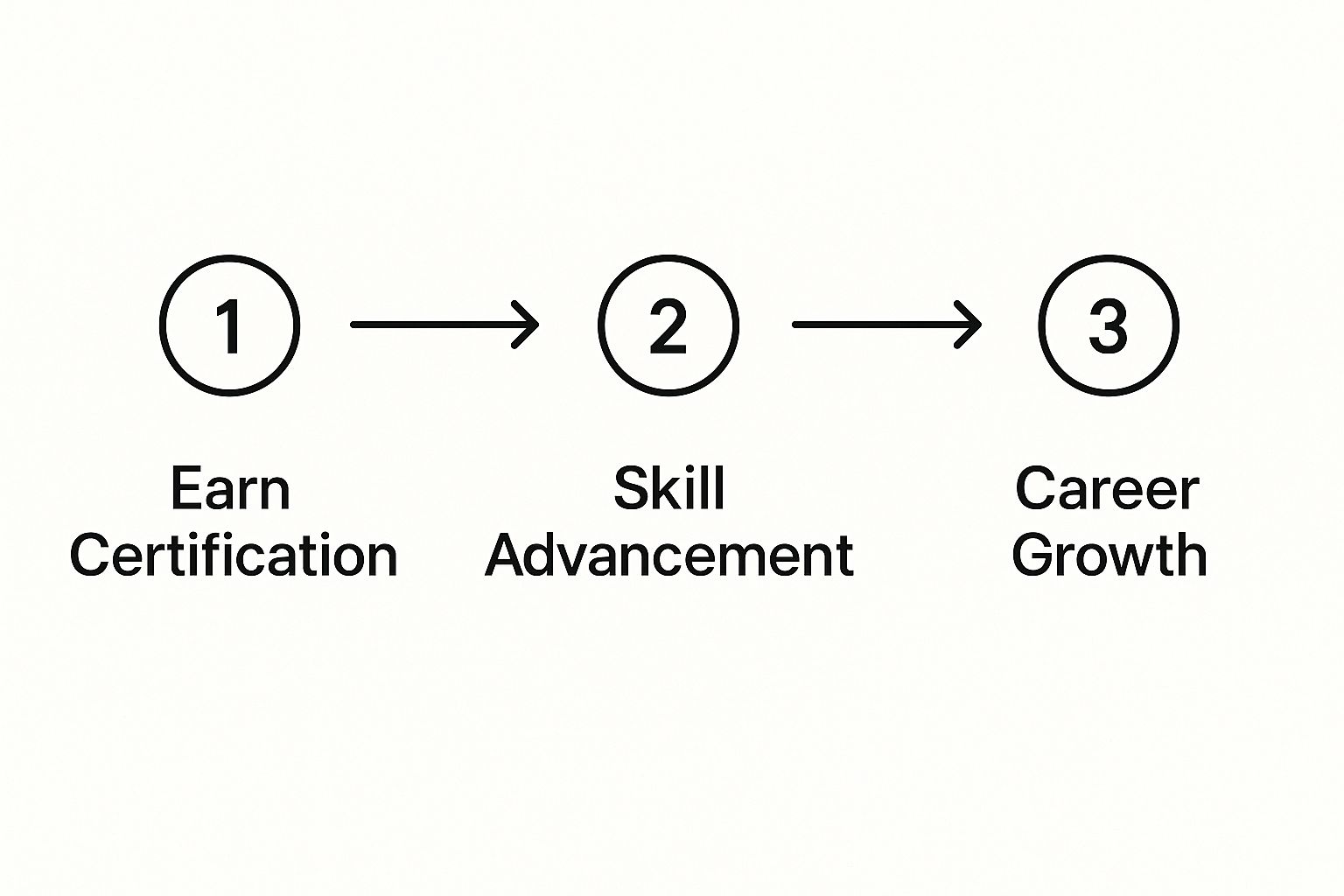
This process isn't just about passing a test; it's about tangible career growth. As you turn those red and yellow items green, you are building real-world skills that directly impact your career trajectory.
 Image
Image
The certification is the starting pistol, kicking off a cycle of skill advancement that leads to real, meaningful career opportunities.
Set Your Exam Date and Work Backward
Okay, let's make this real. Go book your exam. Picking a date creates a finish line, turning a vague "I should get certified" goal into a non-negotiable deadline. For most associate-level exams, giving yourself 8-12 weeks is a solid timeframe if you have some foundational IT knowledge.
With the date on the calendar, you can now work backward to map out your weeks. Look at your color-coded list and dedicate more time to the "red" zones. A typical week might look something like this:
- Monday & Tuesday: Tackle a "red" topic head-on. Let's say it's Azure Networking. Spend these days on core concepts, video courses, and introductory labs.
- Wednesday: Switch gears to a "yellow" topic, like managing user identities. Focus on hands-on practice to build that muscle memory.
- Thursday: Circle back to the "red" topic from Monday, but this time, it's all about practical labs. Build, break, and fix things.
- Friday: Review everything you covered during the week. Cap it off with a short practice quiz focused on just those topics to see what stuck.
This gives your study a predictable rhythm. You’ll build momentum week after week, methodically turning weaknesses into strengths. This systematic Microsoft certification exam prep is the most reliable way I've seen people get across the finish line.
Find the Right Mix of Study Resources
No single resource is a silver bullet. The best approach is to layer different types of materials to reinforce your learning. Here’s a quick comparison to help you build your toolkit.
Microsoft Certification Study Resource Comparison
| Resource Type | Best For | Pros | Cons |
|---|---|---|---|
| Microsoft Learn | Foundational knowledge and official curriculum. | Free, authoritative, well-structured learning paths. | Can be dry; labs are sometimes limited. |
| Video Courses (Pluralsight, Udemy) | Visual learners and conceptual understanding. | Engaging instructors, easy to consume on the go. | Quality varies; can be passive without labs. |
| Hands-On Labs (Azure Portal) | Building practical, real-world skills. | The absolute best way to learn; cements knowledge. | Requires an Azure subscription (can incur costs). |
| Practice Exams (HydraNode) | Identifying weak spots and exam simulation. | Simulates real exam pressure; adaptive learning. | Cost, but a high ROI for exam readiness. |
| Study Groups / Forums | Getting unstuck and seeing other perspectives. | Peer support, real-world problem-solving. | Can be a time-sink if not focused. |
The key is to use a combination. Watch a video to grasp a concept, read the Microsoft Learn module for the official details, then immediately jump into a hands-on lab to make it stick.
Active Learning Strategies That Actually Work
 Image
Image
Let's be real: passively watching videos or skimming articles isn't going to get you a passing score on a Microsoft certification exam. True learning—the kind that sticks—is an active sport. It’s all about rolling up your sleeves, getting your hands dirty with the tech, and genuinely making the knowledge your own.
This is where you bridge the gap between knowing the theory and actually doing the work. A solid microsoft certification exam prep plan is built on active learning. Your goal is to mix and match different study methods to create a powerful, personalized routine that builds real-world competence.
Get Your Hands Dirty with Labs
You can read about configuring a virtual network in Azure all day, but nothing cements that knowledge like actually building, configuring, and inevitably troubleshooting one yourself. There is simply no substitute for hands-on experience.
Thankfully, Microsoft gives you plenty of ways to get this crucial practice:
- Azure Free Account: This is your best friend. It gives you a nice chunk of free credits and access to popular services for 12 months. It’s the perfect sandbox for building and experimenting without worrying about a bill.
- Developer Sandbox: Keep an eye out for these within Microsoft Learn modules. They are temporary, pre-configured environments where you can complete specific tasks without even needing your own subscription.
- Your Own Lab: If your company has a subscription or you're willing to invest a little, setting up your own lab environment gives you total freedom. Explore, break things, and figure out how to fix them. That's where the best learning happens.
The trick is to use these labs to mimic the exam objectives. If an objective says "manage storage account access," you need to get into the Azure portal, create a storage account, and start managing its access keys.
The Feynman Technique: Explain It Like I'm Five
One of the most powerful ways to check your understanding is to try and explain a complex topic in simple terms. This is often called the Feynman Technique, and it forces you to boil a concept down to its absolute essentials.
If you can't explain it clearly to someone with zero background in the subject, you probably don't understand it as well as you think.
Pro Tip: Grab a patient friend, a family member, or even just a rubber duck on your desk. Try explaining what Azure Active Directory is or the real difference between IaaS, PaaS, and SaaS. The second you get stuck or resort to heavy jargon, you've found a knowledge gap you need to patch.
This simple act of talking it out helps move information from flimsy short-term memory into solid long-term understanding. It’s an incredibly effective tool in your microsoft certification exam prep toolkit.
Create Your Own Study Guides
Sure, you can buy pre-made flashcards, but the act of creating your own is a potent form of active learning. When you make a flashcard, you’re forced to pinpoint the most critical information and summarize it.
- Old-School Flashcards: The classic method still works. A term or question on one side ("What is Azure Bastion?") and the answer on the other. Simple and effective.
- Digital Flashcards: Apps like Anki or Quizlet are fantastic. Many use spaced repetition systems (SRS) to show you the cards you struggle with more often, making your review sessions incredibly efficient.
- Mind Maps: For complex topics with lots of moving parts, like Azure networking or security services, drawing a mind map can be a game-changer. It helps you visualize how all the different components connect.
Whatever you do, don't just copy and paste definitions. Rephrase everything in your own words. Draw diagrams. The effort you invest in creating these materials is a study session in itself.
Find Your People in Study Groups
Going it alone can lead to burnout and major blind spots. Connecting with a community or a small study group brings in fresh perspectives and a much-needed support system.
Look for people studying for the same exam on platforms like LinkedIn, Reddit, or Discord. The benefits are huge:
- Teaching to Learn: Just like the Feynman technique, explaining a concept to a fellow student is one of the best ways to lock in your own knowledge.
- Gaining New Perspectives: Someone else might have the perfect real-world example or analogy for a topic that's been giving you trouble.
- Staying Accountable: It’s a lot harder to procrastinate when you know you have a study session scheduled with your group.
The massive shift to the cloud has made certain credentials, like the Microsoft Certified: Azure Administrator Associate, incredibly valuable. This certification proves you have the skills to manage core Azure resources like virtual machines and implement Azure Active Directory. As more companies move to the cloud, the demand for certified Azure pros is through the roof. You can learn more about the most in-demand Microsoft certifications and their impact. This trend makes every bit of effort you put into active learning a smart investment in your career.
Using Practice Exams as a Strategic Tool
Let's be honest, practice exams are your secret weapon for any serious microsoft certification exam prep. But here's the catch: most people use them wrong. They treat them like a simple pass/fail quiz, but that’s a huge mistake.
Think of a practice test as a diagnostic tool—a detailed MRI for your knowledge. It’s designed to show you exactly where you’re strong and, more critically, to shine a bright light on the weak spots that need work.
From Baseline to Benchmark
Jumping into a practice test without a plan is like taking a final exam on the first day of class. The goal isn't a perfect score; it's about establishing a baseline. This first test gives you a raw, unfiltered look at where you stand right now, which is invaluable for focusing your study efforts from day one.
Do this early, maybe after your first quick pass through the study material. The result might be a little humbling, and that's completely fine. Seriously. That first score is just your baseline.
From there, every practice test you take becomes a benchmark. Watching your score climb from 55% to 70% and then to 85% isn't just motivating; it's hard evidence that what you're doing is actually working.
The Art of Meticulous Review
The real learning doesn't happen while taking the test. It happens in the review. Glancing at your score and moving on is probably the biggest opportunity you can miss in your entire prep process. You have to get forensic with it.
- For your wrong answers: Don't just memorize the correct choice. You need to dig in and understand why your answer was wrong and why the other one was right. Was it a concept you completely misunderstood? Or did you just read the question too fast? This is how you build knowledge that sticks.
- For your right answers: This might sound weird, but review your correct answers, too. Be honest: Did you really know it, or was it a lucky guess? If you guessed, treat it like a wrong answer and go study the topic.
A practice exam is a feedback loop. Every single question, right or wrong, is a signal telling you where to focus next. Ignoring that signal is like driving with your check-engine light on—you’re just asking for trouble down the road.
This is exactly what platforms like HydraNode are built for. The AI generates practice tests that adapt to your progress, and the detailed explanations for every answer are a goldmine for anyone deep into microsoft certification exam prep. They nail the "why" behind the answers, which is what you need to pass. For instance, if you're tackling the PL-300 exam, you can find specialized question sets to sharpen your skills. You can start preparing with our PL-300 practice exam questions to see this in action.
Simulating Real Exam Conditions
To really get your money's worth from practice tests, you have to mimic the real exam environment as closely as you can. This is about more than just knowledge; it's about building the mental stamina to perform under pressure. When the real exam feels familiar, anxiety goes way down.
Time Management Drills
Microsoft exams are a race against the clock, and that pressure can make you overthink simple questions. Use your practice runs to master your pacing.
- Start the Clock: Always use the official time limit for the exam. No exceptions.
- Go Dark: Phone away. Close all those extra browser tabs. Tell your family or roommates you need to be left alone.
- No Cheating: Fight the urge to Google an answer mid-test. The whole point is to simulate the real thing, where it's just you and your brain.
This kind of disciplined practice trains you to manage the clock instinctively, so you have plenty of time for every question, especially those tricky case studies or performance-based labs.
Tackling Different Question Formats
Microsoft exams love to throw a mix of question types at you. Practice tests are the perfect playground to get comfortable with all of them before you set foot in the testing center.
| Question Format | How to Approach It in Practice |
|---|---|
| Multiple Choice | Focus on eliminating the obviously wrong answers first. This immediately improves your odds. |
| Case Studies | Read the entire case study first to get the business context. Then, attack the questions. |
| Performance-Based Labs | You have to get your hands dirty. Practice these in a real or sandboxed environment (like an Azure free account) to build muscle memory. |
| "Best" Answer Questions | Look for the key constraint or goal in the question. Multiple answers might seem correct, but only one is the best fit for the scenario. |
By working through these formats over and over, you develop a specific game plan for each. You’ll stop getting bogged down by a long case study or feeling intimidated by a hands-on lab. Instead, they become areas where you feel confident and ready to score points.
Your Final Week and Exam Day Game Plan
 Image
Image
The final stretch before your Microsoft certification exam isn't about cramming. It’s a total strategy shift. Forget trying to learn anything new. Right now, it’s all about smart review, getting your head in the game, and creating a bulletproof plan for the big day.
This last week is for locking in what you already know. Your brain needs this time to file everything away neatly, and trying to force-feed it more information will just lead to panic and burnout. Trust the work you’ve already done. It’s time to let it sink in.
How to Taper Your Studies (and Not Burn Out)
Think of it like a marathon runner winding down before a race. You wouldn't go run a full 26 miles the day before—that would be crazy. In the same way, you need to dial back the intense study sessions so you’re mentally fresh when the clock starts.
Your goal is to switch from learning to recalling. Instead of digging into new video courses, spend your time with light reviews and practice questions. Zero in on the weak spots you found in your earlier practice tests, but keep the sessions short and sweet.
Reviewing your own notes and flashcards is a fantastic use of time now. It reinforces the key ideas in your own words. If you're tackling a specific cert like the PL-300: Power BI Data Analyst, you might find our dedicated PL-300 exam prep guide has some useful last-minute tips.
Your Exam Day Checklist
The best way to beat test-day jitters is to eliminate every possible surprise. Whether you're heading to a test center or logging in from home, a solid checklist means you can walk in feeling like you're in complete control.
- Confirm Everything: 48 hours before, double-check your appointment time, date, and location (or the online proctor link).
- Get Your ID Ready: Make sure your government-issued ID is current and the name on it exactly matches your Microsoft certification profile. This is a classic mistake you don't want to make.
- Know the Rules: If you're going to a test center, look up their rules on personal items. Most give you a locker, but it's good to know for sure.
- Prep Your Space (for Online Exams): Run that system test one more time. Make sure your desk is clear, your room is quiet, and there’s nothing on your desk that isn’t allowed.
- Plan Your Morning: Seriously, leave nothing to chance. Lay out your clothes. Plan a simple, protein-rich breakfast. Know exactly how you’re getting to the test center.
This isn’t just about logistics. It’s a mental warm-up that frees your brain to focus on one thing and one thing only: the exam questions.
The night before, do a quick, light review of your core concepts for an hour, max. Then, stop. The best thing you can do for yourself is to relax and get a full night's sleep. A rested brain is a high-performing brain.
Staying Cool and Managing the Clock
Once the exam starts, your pacing and mindset are everything. These exams are designed to be tough—that's why they're valuable. You will hit questions you don't know the answer to right away. That’s perfectly normal, so don't let it rattle you.
If you get stuck, don't spiral. Use the 'mark for review' feature and keep moving. You can always circle back later with a fresh set of eyes. Knocking out the questions you do know first builds confidence and momentum. Plus, it ensures you don't leave easy points on the table because you ran out of time.
Finally, keep the big picture in mind. This certification is a major step for your career. The data doesn't lie: certified pros earn more. A recent IT skills survey highlighted that professionals with Microsoft certifications in hot areas like Azure architecture and security are among the top earners. It's a clear return on the investment you're making with your microsoft certification exam prep. Keeping that in mind can be a powerful motivator when you’re in the thick of it.
Got Questions About Microsoft Certs? We've Got Answers
Stepping into the world of Microsoft certifications can feel like navigating a maze. A ton of questions pop up, from wondering if you're "ready" to figuring out what happens if you don't pass on the first try. Getting solid answers is a huge part of your microsoft certification exam prep, so let’s clear up some of the most common ones I hear.
How Much "Real-World" Experience Do I Actually Need?
This is the big one, right? Especially for those associate-level exams. The honest-to-goodness answer is: it depends, but probably less than you're thinking. For the Fundamentals exams, Microsoft designs them for newcomers, so you can jump in with zero practical experience.
When you get to the Associate level, like the Azure Administrator Associate, Microsoft's official line is to have about six months of hands-on experience. But let’s be real—that’s not a hard-and-fast rule. The true test is whether you can apply the concepts from the exam objectives to solve problems.
If you’ve been grinding through hands-on labs, spinning up your own projects in a free Azure account, and can confidently talk through the core services, you’re building the exact kind of experience they’re looking for. Don’t let the lack of a specific job title stop you if you've been putting in the work.
Think of it this way: the exam is testing your problem-solving skills with the tech, not your resume. Consistent, focused lab work is more than enough to bridge that so-called "experience gap."
So, How Do I Pick My First Certification?
With so many certs out there, it's easy to get analysis paralysis. The best way to cut through the noise is to tie your choice directly to your career goals. Don’t just chase whatever certification is trending; pick one that gives you skills you can use tomorrow in your current job or in the one you're aiming for.
A great first step is to browse job descriptions for roles that excite you. What skills and certifications keep popping up?
- Cloud Infrastructure: If you want to be the one managing cloud environments, the Microsoft Certified: Azure Administrator Associate (AZ-104) is a no-brainer. It's a highly respected and practical choice.
- Data and Analytics: For anyone who loves digging into data to find the story, the Power BI Data Analyst Associate (PL-300) is a fantastic, industry-recognized credential.
- Security Focus: If you're drawn to the world of cybersecurity, the Security, Compliance, and Identity Fundamentals (SC-900) is the perfect launchpad.
Once you’ve got a potential target, find the "skills measured" document for that exam. Read through it. Do the topics get you fired up? Does it sound like work you’d actually enjoy? That genuine interest is what will keep you going when the studying gets tough. If you're curious about a specific path, you can check out our deep dive on what to expect from the PL-300 exam.
Okay, But What If I Fail the Exam?
First off, take a breath. It happens. Failing a certification exam isn't a judgment on your intelligence or your future in tech. It’s just a data point showing you where the knowledge gaps are. I know plenty of incredibly successful IT pros who have failed an exam. Honestly, it’s almost a rite of passage.
Microsoft gives you a score report that breaks down how you did in each skill area. That report is gold. It’s your personalized roadmap for round two, showing you exactly where you went wrong.
Instead of just re-reading the entire textbook, get surgical. Zero in on the sections with the lowest scores. Go back to those specific Microsoft Learn modules, find more hands-on labs for those topics, and use practice questions that target those specific weaknesses. Treat it like a focused mission to turn those weak spots into your strengths. Then, go back and ace it.
Ready to turn practice into a passing score? HydraNode delivers AI-generated practice tests that adapt to your unique knowledge gaps, providing detailed explanations that build true understanding. Stop guessing and start mastering the material by visiting https://www.hydranode.ai.