
Your Guide to Enterprise Learning Management Systems
Picture this: you’re trying to train thousands of employees scattered across different countries, all using a jumble of spreadsheets and emails. It's pure chaos. This is where an enterprise learning management system (LMS) steps in, acting as a centralized digital campus for your entire organization. It's much more than a simple library for courses; it's the engine that drives, automates, and tracks all your company's training and development initiatives.
What Is an Enterprise Learning Management System?
So, what separates an enterprise-grade LMS from a standard one built for smaller teams? Think of it like the difference between a small town library and a massive university's entire library system. Both have books, but the university system is engineered for a huge, diverse population with very specific needs, from specialized departmental resources to integrated campus-wide technology.
An enterprise LMS is the strategic backbone for developing your people. It handles everything from a new hire’s first day of onboarding and critical compliance training to sophisticated leadership programs and certifications for your business partners. Its core job is to give every single person connected to your company a clear, easy-to-follow path to gain the skills they need to excel.
Built for Scale and Complexity
What truly sets an enterprise learning management system apart is its fundamental design. These platforms are built from the ground up to manage the sheer scale and complexity that large organizations deal with every day.
This usually involves:
- Global Workforces: Delivering a consistent training experience to people in different time zones, languages, and cultures.
- Complex Hierarchies: Creating unique learning journeys for countless departments, job roles, and seniority levels.
- Extended Enterprise: Training people outside your company—like customers, sales partners, and suppliers—in their own secure, branded learning spaces.
This power to scale is fueling incredible market growth. The corporate LMS market was valued at around USD 12.02 billion in 2024 and is expected to explode to USD 72.30 billion by 2034. That's a compound annual growth rate of nearly 20%, which shows just how vital these systems have become. You can dig deeper into this trend in the full corporate learning management system market report.
An enterprise LMS isn't just another piece of software; it's a strategic asset that transforms how you develop talent. It bridges the gap between scattered training efforts and a unified, impactful learning culture.
At the end of the day, these systems go far beyond just hosting courses. They become a core part of business strategy. They help you lower risk by automating compliance tracking, grow revenue by getting sales teams up to speed faster, and improve retention by showing employees you’re invested in their careers. By centralizing everything, an enterprise LMS gives leaders a clear view of skill gaps, training ROI, and the overall health of their workforce.
7 Key Features of an Enterprise LMS
What truly separates a simple training tool from a genuine enterprise learning management system? It’s not just a longer menu of options. It's a suite of powerful, interconnected features built specifically for the complexities of a large organization. These components work in harmony to solve real business challenges, from managing a global workforce to proving the financial return on your training budget.
Think of it this way: a basic training tool is like a simple hammer. It's great for a single, straightforward task. But an enterprise LMS is like a complete, professional-grade workshop. It has specialized tools that connect and work together, allowing you to build something complex, durable, and sophisticated.
Advanced Analytics and Reporting
For any business leader, data is the language of value. Enterprise-level systems offer robust analytics that dig much deeper than simple course completion rates. They feature detailed dashboards designed to connect training activities to tangible business results, like a drop in employee churn or a faster ramp-up time for new sales reps.
This is what allows the C-suite to finally see a clear return on investment (ROI). For instance, a global retailer could use its LMS analytics to find a direct correlation between product knowledge training and a 15% increase in sales at specific stores. That’s how you prove the direct financial impact of your learning programs.
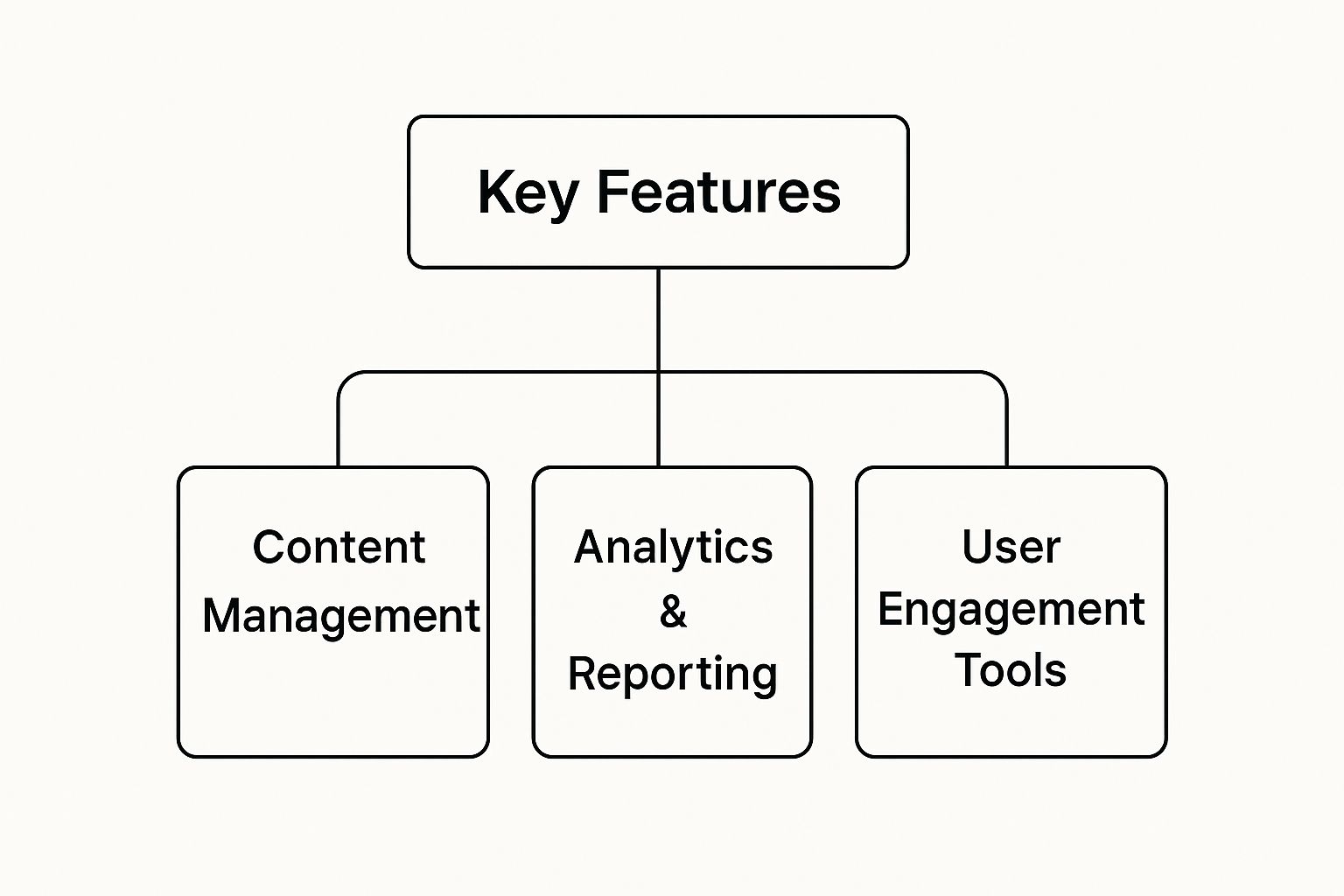
The diagram below shows how these core features often work together to support the entire organization.
 Image
Image
As you can see, a successful platform isn't just about content. It's about balancing content creation, user engagement, and meaningful measurement.
Seamless Scalability and Integrations
An enterprise LMS has to grow with your business, not hold it back. Scalability is non-negotiable. It means the system can support tens of thousands of users at the same time, across different continents, without a single hiccup. Whether your company doubles in size overnight or acquires another business, the platform must handle the load effortlessly.
Just as critical are its integrations. These platforms are not meant to be isolated islands. They are built to be the central learning hub within a larger tech ecosystem, connecting seamlessly with your other essential software to create automated, efficient workflows.
Here are a few common examples:
- Human Resources Information System (HRIS): New hires are automatically enrolled in their onboarding curriculum the moment their profile is created in the HR system. No manual work needed.
- Customer Relationship Management (CRM): You can link sales training records directly to performance data in your CRM (like Salesforce), making it easy to see how well-trained reps perform against their quotas.
- Single Sign-On (SSO): Employees can access the LMS using their standard company login. This removes the headache of remembering another password and keeps access secure.
To help clarify how these features translate into solutions, here is a quick breakdown of some essential components.
Essential Enterprise LMS Feature Breakdown
| Feature | Description | Business Problem Solved |
|---|---|---|
| Advanced Reporting | In-depth analytics dashboards that track learning metrics against key performance indicators (KPIs). | Proving training ROI and making data-driven decisions about L&D spending. |
| Integrations | The ability to connect the LMS with other business systems like HRIS, CRM, and collaboration tools. | Automating administrative tasks, creating a unified tech stack, and eliminating data silos. |
| Scalability | The system's capacity to handle a massive number of users and activity without performance degradation. | Supporting business growth, mergers, and global expansion without needing to re-platform. |
| Multi-Tenancy | Creating separate, branded learning environments for different audiences within one platform instance. | Training external audiences (customers, partners) securely and efficiently, often creating new revenue streams. |
| Mobile Learning | A fully responsive design and/or native mobile app for on-the-go access to training. | Meeting the needs of a modern, flexible workforce and enabling learning anytime, anywhere. |
| Compliance Management | Tools for assigning, tracking, and reporting on mandatory training and certifications. | Reducing organizational risk, ensuring regulatory adherence, and simplifying audit processes. |
| AI & Automation | Using artificial intelligence for personalized course recommendations, content curation, and automating tasks. | Improving learner engagement, reducing administrative overhead, and delivering relevant content at scale. |
Ultimately, the best enterprise systems don't feel like another piece of software employees are forced to use. They become a natural, almost invisible part of the company's daily operations.
Multi-Tenancy for Diverse Audiences
Finally, one of the most powerful features for large organizations is multi-tenancy. This gives you the ability to use a single LMS to serve multiple, completely separate audiences. Each "tenant" or portal can have its own branding, content library, user groups, and administrative rules.
For example, a software company could use one LMS to create distinct, secure learning portals for:
- Internal Employees: For their onboarding, compliance training, and ongoing professional development.
- Customers: To offer product tutorials that boost user adoption and dramatically lower the number of support tickets.
- Channel Partners: To deliver sales enablement materials and certification programs that help them sell more effectively.
This single feature can transform an LMS from an internal cost center into a strategic asset that drives revenue and builds loyalty across your entire business ecosystem. You can explore a breakdown of similar advanced system components and find more information on the key features of modern learning platforms to see how they align with specific business goals.
The Real Business Impact of a Corporate LMS
Thinking of an enterprise LMS as just another software purchase is a mistake. It’s a serious investment in your company's most important asset: your people. The real magic happens when you stop focusing on just course completions and start connecting the dots between training and real-world business results. When done right, an LMS delivers outcomes that get noticed in the boardroom.
Here's an analogy I like to use: giving your team a basic map is one thing, but building them a high-speed railway is something else entirely. A map is useful, sure. But the railway fundamentally changes how efficiently people and resources get where they need to go, creating a huge economic lift. An enterprise LMS does the same for knowledge—it builds fast, reliable pathways that directly fuel business performance.
 Image
Image
This isn't just theory; the market growth tells the story. The learning management system market was valued at USD 24.05 billion in 2024 and is expected to climb to an incredible USD 70.83 billion by 2030. What's behind this surge? Companies are scrambling to manage remote training and address persistent skill gaps, especially with hybrid work models becoming the norm. You can discover more about these market trends if you want to dig deeper into the data.
Driving Productivity and Reducing Costs
One of the first places you’ll see a return is in employee onboarding. A centralized, automated onboarding process gets new hires contributing much faster. It dramatically shortens that initial "time-to-productivity" window. Take a company like Automox, for example. They managed to slash their manual onboarding efforts by 75% simply by putting a structured LMS program in place.
That same efficiency applies directly to compliance training. Automating the assignment and tracking of mandatory courses turns a logistical nightmare into a smooth, auditable process. This drastically cuts the risk of facing expensive fines or legal trouble.
A corporate LMS transforms training from a cost center into a powerful engine for growth. It directly addresses key business challenges like employee retention, skill gaps, and risk management, delivering a clear return on investment.
Boosting Engagement and Closing Skill Gaps
A great learning culture is a magnet for talent. When your team sees clear opportunities to grow and feels the company is genuinely investing in their careers, they're far more engaged and much less likely to look elsewhere. An LMS makes that investment tangible and easy to access.
It also gives you the tools to get ahead of skill gaps before they become critical problems. By looking at performance data alongside training results, leaders can launch targeted upskilling programs. This ensures your workforce has the skills needed to tackle whatever comes next, which is essential for staying competitive. The overall impact of a corporate LMS on your business is far-reaching, touching everything from daily operations to long-term strategy.
How to Choose the Right Enterprise LMS
Picking an enterprise LMS can feel like you're lost in a massive, overwhelming tech marketplace. With so many options out there, all promising the world, a structured approach is the only way to cut through the noise and make a decision you won't regret later. This isn't just a software purchase; it's a long-term partnership. You're looking for a platform—and a team—that lines up with where your business is headed.
The first move? Assemble a cross-functional selection team. Don't make this an IT-only decision. You absolutely need people from IT, HR, and key business units at the table. Most importantly, you need to include the people who will actually be using the system—your learners. This approach brings every perspective into the room, from technical must-haves to user experience, and helps build support for the project across the entire company right from the start.
Once your team is ready, it's time to figure out what you really need. What business pains are you trying to fix? It's easy to get distracted by a long list of shiny features, so stay focused on your absolute non-negotiables.
Define Your Core Requirements
Before you even glance at a vendor's website, you need a crystal-clear checklist of what a successful LMS looks like for your organization. This simple step will keep you from getting swayed by a slick sales pitch for features you'll never use.
Break down your requirements into a few key areas:
- Technical Needs: Does the LMS have to play nice with your specific HRIS or CRM? What are your non-negotiable security and data privacy standards?
- Functional Needs: Do you need multi-tenancy to train partners or customers? Is a killer mobile experience a must-have for your on-the-go teams?
- Administrative Needs: How straightforward is it to build courses and assign them? What kind of reports and analytics do you need to show the C-suite that this was a worthy investment?
This demand for more capable training platforms is fueling a massive market boom. The global corporate LMS market was valued at USD 11.4 billion in 2025 and is on track to hit an incredible USD 46.5 billion by 2034. This explosive growth shows just how critical these systems have become for modern businesses. You can dive into the full corporate LMS market analysis to see what’s driving this trend.
Evaluate Vendors and Ask the Right Questions
With your requirements list in hand, you can finally start looking at vendors. But don't just rely on their marketing fluff. Get them on the phone for an in-depth product demo. This is your opportunity to see the platform in action and grill them with specific, tough questions.
Choosing an LMS is a long-term commitment. Focus on finding a true partner who is invested in your success, not just a vendor trying to close a sale. Look for a team that understands your industry and is transparent about their product's strengths and limitations.
During these demos, make sure you ask questions that go beyond the feature list:
- Can you show us a real-world example of how a client uses your system to solve a problem similar to ours? This forces them to move past the generic script and get practical.
- What does your implementation process look like, and what resources do you provide to ensure a successful launch? You're looking for a clear, structured plan and dedicated support, not just a software key.
- What is on your product roadmap for the next 12-18 months? This tells you if they are coasting or actively innovating for the future.
- How do you handle customer support? What are your standard response times for critical issues? A fantastic product can become a nightmare if the support is terrible.
- Can we speak with a few of your current customers who are similar to our size and industry? Nothing beats the honest truth from a real user.
By focusing on your specific needs and thoroughly vetting potential partners, you can find an enterprise LMS that works for you today and grows with you tomorrow. It's also a good idea to look at vendor pricing models early in the process to make sure they fit your budget.
Your Roadmap for a Successful LMS Rollout
 Image
Image
So, you’ve picked your vendor and signed the contract. Congratulations! Now the real work begins. Choosing the right platform is only half the battle; how you roll it out is what truly determines whether your team embraces it or ignores it. A rushed, poorly planned launch can sink even the most powerful enterprise learning management systems.
Think of it like building a new subway line in a packed city. You don't just shut down all the roads and start digging. That would be chaos. Instead, you need a smart, phased plan, clear communication to keep everyone informed, and a strategy to keep things running smoothly during the transition. A "big bang" approach to an LMS launch often creates the same kind of gridlock—confusion, frustration, and very low engagement.
Here's how to do it right, broken down into three manageable phases.
Phase 1: The Kickoff and Strategic Plan
First things first: you need a game plan. Start by putting together your core implementation team. This isn't just an IT project; you'll need the project manager, of course, but also folks from IT, your L&D content team, and, critically, representatives from the departments who will actually be using the system day-to-day.
This group's first job is to get on the same page. Map out a detailed project timeline with realistic milestones. Everyone needs to agree on the scope, the goals, and how you’ll measure success (your KPIs). This is also where you iron out the technical nuts and bolts, like connecting the LMS to your HR system or CRM and setting up single sign-on (SSO) so people don't have to remember another password.
Phase 2: Content Migration and The Pilot Program
With your blueprint in hand, it’s time to think about the content. Moving all your existing courses and materials over can be a huge job, so don't try to boil the ocean. Be strategic. Identify the most important content to move first—think new hire onboarding, essential compliance training, or popular upskilling courses.
Once you have that foundational content loaded, it's time for a pilot program. This is a non-negotiable step. Get a small, controlled group of actual users to test drive the platform. Why is this so important?
- You'll find the bugs. It’s much better for a handful of people to find a glitch than your entire company.
- You'll get honest feedback. Pilot users will tell you what’s clunky, what’s confusing, and what they love.
- You'll create evangelists. These early users become your internal champions, spreading the word and helping their colleagues when it’s time for the full launch.
A phased rollout that includes a pilot program isn't just a best practice; it's a risk mitigation strategy. It allows you to learn, adapt, and build momentum, ensuring a much smoother and more successful company-wide launch.
Phase 3: The Marketing Push and Full Rollout
This is it—the main event. And you should treat it like one. Don't just flip a switch and send a memo. You need to build buzz and excitement. Treat your LMS launch like an internal marketing campaign.
Use company newsletters, all-hands meetings, and team huddles to announce the launch. More importantly, tell people what's in it for them. Will they have easier access to training? New opportunities for career growth? A better, more modern learning experience? Sell the benefits, not just the features.
Make sure you provide solid training for managers and admins so they know how to pull reports and track their team's learning. As the platform goes live for everyone, keep the feedback channels wide open. A successful implementation isn’t a finish line; it’s the start of an ongoing cycle of listening, tweaking, and improving.
Measuring the ROI of Your LMS Investment
 Image
Image
Sooner or later, you're going to have to prove your LMS was a smart investment. To keep your budget and get stakeholders excited for what's next, you need to show them the money. That means connecting what happens in your training platform to real, tangible business results.
It's about moving past vanity metrics like "course completions" and focusing on what really matters to the bottom line. A solid return on investment (ROI) case isn't just about the hard numbers, though. It's a blend of concrete financial wins and the less tangible, but equally important, improvements you see in your people and processes.
Tracking Quantitative Returns
Let's start with the easy stuff: the direct financial gains. These are the metrics that leadership can instantly understand and that carry a lot of weight in any budget meeting.
Here are a few to zero in on:
- Reduced Training Costs: Tally up everything you're not spending money on anymore. Think flights and hotels for instructors, conference room rentals, and stacks of printed handbooks.
- Faster Time-to-Productivity: How quickly does a new hire start pulling their weight? Measure the time it takes for them to hit their first sales quota or performance benchmark. This directly ties training to revenue.
- Lower Compliance Fines: If you're in a regulated industry, this one is huge. Track the drop in penalties now that mandatory training is automatically assigned, tracked, and documented.
An effective enterprise LMS doesn’t just manage training; it creates serious operational efficiency. We've seen companies cut the manual work involved in onboarding by as much as 75%. That’s a massive amount of time your team gets back for more important, strategic work.
When you pair these hard-dollar savings with the softer benefits—like a jump in employee engagement scores or a drop in turnover—you're not just justifying a purchase. You're showing that your LMS isn't a cost center; it's a strategic tool that's actively driving the business forward.
Your Enterprise LMS Questions, Answered
Jumping into the world of enterprise learning management systems naturally brings up a lot of questions. I get it. To help clear things up, here are some straightforward answers to the questions I hear most often.
Enterprise Vs. Regular LMS: What’s the Real Difference?
The biggest difference boils down to scale and complexity. Think of a standard LMS as a dependable sedan—perfect for smaller teams or straightforward training needs. An enterprise LMS, on the other hand, is more like a fleet of industrial trucks. It’s built from the ground up to handle the heavy lifting of a large, global business with thousands of users and complex organizational structures.
A few things really set an enterprise-grade system apart:
- Advanced Security: We’re talking about protocols built to protect sensitive corporate data and user information on a massive scale.
- Multi-Tenancy: This is the ability to create separate, fully-branded learning portals for different groups—employees, customers, channel partners—all from one central system.
- Deep Integrations: They're designed to seamlessly connect with the other core systems that run your business, like your HRIS or CRM.
- Powerful Reporting: You get customizable analytics that go beyond simple completion rates to deliver real business insights to stakeholders.
If your training goals are relatively simple and your audience is small, a standard LMS might be all you need.
How Long Does Implementation Actually Take?
This is the classic "it depends" answer, but I can give you some realistic timelines. For a fairly standard setup without a ton of custom work, you're likely looking at a 2-4 month implementation window.
However, if you're a global company planning a large-scale deployment, the project gets much bigger. You'll be dealing with complex data migration, unique branding for different business units, and deep integrations with other enterprise software.
For a complex, global rollout, you should realistically budget 6-12 months, and sometimes even longer. My advice? Always opt for a phased implementation. It’s the best way to manage the complexity and make sure the transition is smooth for everyone involved.
Can I Use It to Train Customers and Partners, Too?
Yes, and you absolutely should! This is one of the most powerful features of a true enterprise LMS, often called "extended enterprise" training. It’s a game-changer.
Using a feature like multi-tenancy, you can easily spin up secure, custom-branded learning environments for anyone outside your company. Imagine offering product training to new customers to improve adoption, running certification programs for your resellers, or providing sales materials to your freelance partners.
This transforms your LMS from a simple internal tool into a strategic asset that can directly generate revenue and foster loyalty way beyond your own four walls.
Ready to streamline your IT certification prep with a smarter learning platform? HydraNode uses AI to create practice tests that adapt to your unique needs, helping you study more efficiently and pass your exams with confidence. Discover a better way to get certified at https://www.hydranode.ai.