
How to Improve Critical Thinking Skills: A Practical Guide
Look, 'critical thinking' gets thrown around a lot, often sounding like some dry, academic term. But in reality, it's one of the most practical, real-world skills you can possibly build. This isn't about outsmarting everyone in the room. It’s about getting better at questioning, analyzing, and making sense of the tidal wave of information that comes at us every single day.
Most of us weren't formally taught how to think this way. We know it's important, but actually feeling confident in our ability to do it? That's a different story.
This isn't just a hunch; the numbers back it up. A revealing 2020 study on the state of critical thinking found that while 94% of people believe it's essential, a massive 86% feel these skills are seriously lacking across society. What’s even more surprising is that nearly a quarter of those surveyed felt their own critical thinking had actually gotten worse since high school.
This gap is a big deal. We're all expected to solve complex problems and make smart decisions, yet the very skill that underpins it all is often an afterthought.
What Does Thinking Critically Actually Involve?
So, what are we really talking about when we say "critical thinking"? It’s not just one thing. It's more like a mental toolkit—a set of cognitive skills that work together to help you cut through the noise.
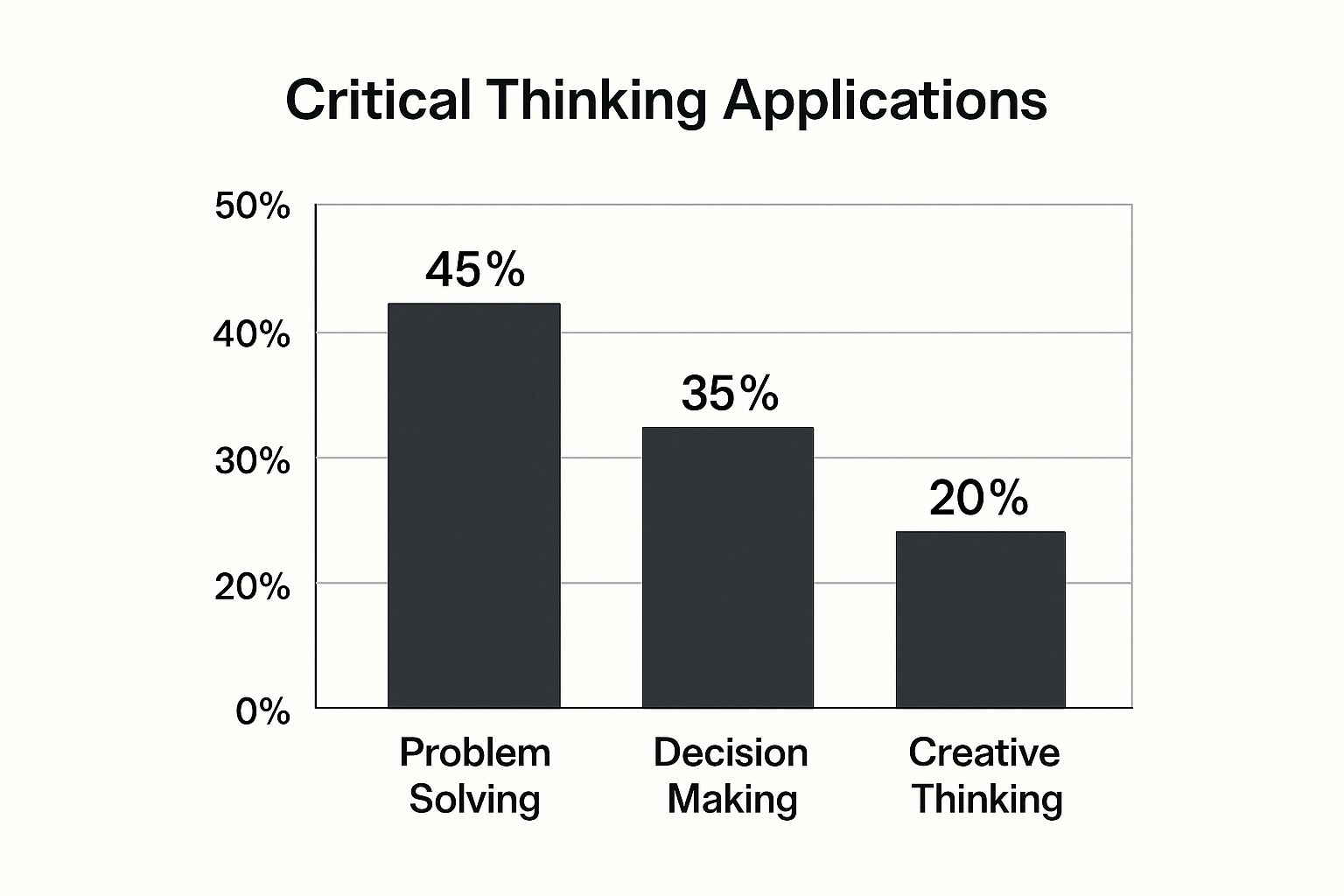
These skills are directly applied to the most important areas of our professional and personal lives.
 Image
Image
As you can see, problem-solving and decision-making are where the rubber really meets the road, showing just how crucial this skillset is for tangible, everyday outcomes.
To really get a handle on how to improve, it helps to break the process down into its core components. I like to think of them as the four pillars of critical thinking.
This table lays out each pillar, what it means, and what it looks like in a real-life situation.
The Four Pillars of Critical Thinking
| Pillar | Definition | Real-World Example |
|---|---|---|
| Analysis | Breaking down information into its fundamental parts to understand its structure and relationships. | Reading a news article and separating the reported facts from the author's opinion and potential bias. |
| Inference | Drawing logical conclusions based on evidence and reasoning, rather than direct statements. | Noticing a coworker is consistently missing deadlines and inferring they might be overworked or need support, not just lazy. |
| Evaluation | Assessing the credibility, relevance, and strength of arguments, claims, and sources of information. | Comparing different product reviews online, filtering out sponsored content and focusing on verified purchasers' feedback. |
| Explanation | Clearly and coherently articulating your own reasoning and the evidence that supports your conclusions. | Presenting a business proposal and justifying your budget requests with market data and projected ROI. |
Thinking through these pillars gives you a concrete framework for tackling problems.
Of course, mastering them doesn't happen by accident. It takes consistent, deliberate practice. The good news is that there are structured ways to build these mental muscles. You can use daily exercises, but you can also find platforms offering adaptive practice tests, like the AI-driven tools you’ll find if you explore the HydraNode certification platform. These can be incredibly effective because they target your specific weak spots and create customized challenges to help you improve.
How to Diagnose Your Own Thinking Habits
 Image
You can't fix what you can't see. Before you start piling on exercises, the most powerful thing you can do is take an honest look at how you already think. This isn't about judging yourself. It’s about building awareness.
Image
You can't fix what you can't see. Before you start piling on exercises, the most powerful thing you can do is take an honest look at how you already think. This isn't about judging yourself. It’s about building awareness.
Most of us cruise through the day on cognitive autopilot. We rely on mental shortcuts and baked-in biases without a second thought. The first real step toward improvement is simply observing these patterns in the wild. It’s like a mechanic listening intently to an engine before ever reaching for a wrench—you have to diagnose the problem first.
Think about the last news article you read or a proposal you heard at work. Did you find yourself hunting for facts that supported what you already believed? That’s a textbook case of confirmation bias, and it’s one of the most common traps we all fall into.
Pinpointing Your Personal Biases
Cognitive biases aren't character flaws. They’re bugs in our mental software—features that help us process a staggering amount of information quickly. But they can absolutely sabotage your ability to think critically.
To start your own diagnostic, just pay attention to your gut reactions. Ask yourself some tough questions and see what comes up.
Here are a few common biases to look for in your day-to-day life:
- Confirmation Bias: Do you actively seek out opinions that challenge your own? Or do you stick to the comfortable echo chamber of sources you know will agree with you? Be honest.
- Anchoring Bias: Think about a negotiation. How much does that first piece of information—the initial price of a car, for instance—steer the entire conversation? That initial number "anchors" your perception of value.
- The Dunning-Kruger Effect: This is a tricky one. It’s our tendency to overestimate our own competence in areas where we have little knowledge. At the same time, true experts often underestimate their skills. Do you find yourself feeling supremely confident about topics you've only just scratched the surface of?
A Note on Self-Assessment: This only works if you approach it with humility. The goal isn’t to beat yourself up. It's to observe your thought process like a neutral third party. This kind of detached self-reflection is where real growth begins.
Just becoming aware of one or two of these patterns can fundamentally change how you engage with new information. It gives you the power to hit pause and choose a more deliberate path, rather than letting your automatic brain run the show.
A Practical Checklist for Self-Diagnosis
To get more specific, try running this checklist against a recent decision you made or a strong opinion you hold. Take a moment to consider each question.
| Question to Ask Yourself | What It Reveals About Your Thinking |
|---|---|
| What evidence actually made me believe this? | Your reliance on solid proof versus just a feeling. |
| Did I seriously consider any opposing views? | Your openness to seeing the other side. |
| What was I feeling when I made this decision? | The influence of emotions on your logical process. |
| Who really benefits from me believing this? | Your awareness of outside influences and hidden agendas. |
This kind of structured reflection helps you shift from being a passive consumer of information to an active, critical evaluator. It’s a habit that snowballs, making it easier to spot these biases in real-time.
If you’re looking for a more objective benchmark, structured assessments can give you a clearer picture. For a deep dive into your current analytical skills, you can get a baseline with the AI-powered practice exams from HydraNode. These can help you zero in on specific weak spots.
By doing these mental spot-checks regularly, you start to build a personalized roadmap for your own development. You'll know exactly which habits to work on, making your efforts far more targeted and effective.
Build Your Analytical Muscle with Daily Exercises
 Image
Image
So, you’ve got a clearer picture of your own thinking habits. Now comes the fun part: moving from diagnosis to action.
Let's be clear—sharpening your critical thinking isn't about blocking out huge chunks of your day for some grueling mental marathon. It’s all about weaving small, consistent habits into your daily life. The goal is to turn passive consumption into active analysis.
Think of it like getting in shape. You wouldn't go to the gym for eight hours once a month and expect results. Real strength comes from regular, targeted workouts. The same exact principle applies to your mind. These quick habits are designed to be simple and repeatable, but they pack a serious punch over time.
Deconstruct One Argument Every Day
One of the most effective ways to hone your evaluation skills is to start dissecting the arguments you run into every single day. This doesn’t have to be some formal, academic debate. It could be a news editorial, a marketing pitch in your inbox, or even a persuasive post you scroll past on social media.
Your mission is simple: find the core argument and tear it apart.
- What’s the main claim? Boil it down to a single sentence. What is the one thing the author is trying to convince you of?
- What’s the evidence? List the facts, stats, or stories they're using to prop up that claim.
- What are the assumptions? This is often the weakest link. What are they assuming you already believe for their argument to hold water?
Let’s say you see an ad that screams, "Our new productivity app will save you 10 hours a week!" The claim is obvious. The evidence might be a tiny user survey. The massive assumption? That your workflow is anything like the people in their survey and that you'll use the app in the exact same way.
Breaking things down like this forces you to see past the polished surface and check the structural integrity of what you're being told.
Use the Socratic Method on Yourself
The Socratic method isn't just for dusty philosophy books; it's an incredibly practical tool for stress-testing your own beliefs. At its core, it's just a disciplined way of asking questions to dig deeper and expose shaky assumptions.
The next time you catch yourself with a strong opinion, just pause and play the role of a gentle interrogator.
- Clarify: "What do I actually mean by this? Why do I believe it's true?"
- Challenge: "What if my main assumption here is flat-out wrong? What would that change?"
- Find Evidence: "What specific proof do I have for this? Is it really solid?"
- Consider Alternatives: "What's the counter-argument? Could a reasonable person see this differently?"
- Examine Consequences: "So what? What are the logical implications if I'm right? Or if I'm wrong?"
This little routine keeps your beliefs from getting stale and ensures they’re built on solid reason, not just habit or gut feelings.
Why This Works: This systematic self-questioning is a direct countermeasure to our built-in cognitive biases. It forces you to actively engage with your thoughts instead of just accepting them, which is the very essence of sharp critical thinking.
Practice with Structured Assessments
While these daily habits build a powerful foundation, structured practice can seriously accelerate your growth. It puts you in a controlled environment to work on specific reasoning skills. This is where modern tools can create a focused training ground to test your abilities against tricky, real-world scenarios.
AI-driven platforms are a game-changer here. They can serve up dynamically generated problems that adapt to your skill level, pushing you just enough to improve without getting overwhelmed. You might be challenged to spot the logical fallacy in a dense paragraph or draw the most likely conclusion from a messy set of data.
The real magic is the immediate, detailed feedback. These platforms don't just tell you the right answer; they explain why it's right. This creates a powerful learning loop that's almost impossible to replicate on your own.
If you want to add this kind of targeted training to your routine, exploring the different HydraNode subscription options gives you access to a huge bank of these adaptive questions. It’s the perfect complement to your daily informal exercises, helping you build a truly well-rounded critical thinking toolkit.
Applying Critical Thinking When the Stakes Are High
Daily exercises are great for building your mental muscles, but the real test comes when the pressure is on. This is where critical thinking leaves the classroom and enters the real world—in high-stakes work projects, major financial choices, and even just trying to separate fact from fiction online.
Thinking clearly under pressure isn't some gift you're born with; it's a discipline you practice. It means pushing past your gut reaction to methodically unpack a situation. This is where a lot of people stumble, not because they aren't smart, but because this kind of thinking is rarely taught directly.
In fact, a massive 2024 meta-analysis that looked at 48 years of data found something telling about college students. While many do improve their critical thinking skills, the growth is surprisingly inconsistent. Over a third of students showed no significant gains at all, which really drives home the point: you have to be intentional about developing this skill. You can discover more insights from the full analysis on how targeted practice can make all the difference.
Let's walk through a couple of common scenarios to see what this looks like when the rubber meets the road.
Scenario One: Making a Major Team Purchase
Picture this: your team needs new project management software. The heat is on to pick the right one. A bad choice could sink thousands of dollars and derail everyone's workflow for months.
Someone not thinking critically might get dazzled by a slick demo. They'd focus on the flashy features or maybe just the lowest price tag, making a snap decision based on a persuasive sales pitch.
But a critical thinker? They approach this like an investigator. They slow the whole process down and start asking the real questions.
- Uncovering Hidden Costs: "Sure, the monthly subscription is cheap, but what about implementation fees? Are we going to get hit with a massive bill for training? And what's the cost of migrating all our data from the old system?"
- Investigating Integration Friction: "How well does this software actually play with the tools we already use every day, like Slack or our cloud storage? Is it going to create more work by forcing everyone to jump between different apps?"
- Anticipating Human Resistance: "My team is comfortable with our current system. How steep is the learning curve here? What's our game plan for getting everyone on board without causing mass frustration and a productivity nosedive?"
The Key Takeaway: A critical decision-maker looks past the "what" (the features) to dissect the "how" (the real-world impact on cost, workflow, and people). They're looking at the entire system, not just the shiny new piece.
This mindset forces you to actively hunt for potential problems instead of just accepting the rosy picture someone is selling you. It’s all about thinking through the second and third-order consequences before you're locked in.
Scenario Two: Dissecting a Viral Social Media Claim
You're scrolling and see a shocking post making a bold claim. It's racking up thousands of shares, and you even see a few friends have passed it along. The emotional pull is strong, and your first impulse might be to believe it—or even share it yourself.
This is a critical moment. It's your chance to engage your brain instead of getting swept up in the outrage. A critical thinker doesn't just react; they pause and start asking questions.
Here's the kind of mental checklist they run through:
- Check the Source: Who is actually making this claim? Is it a well-known news organization with a track record of accuracy, or is it an anonymous account or a blog that thrives on sensationalism?
- Spot the Emotional Strings: Is the language designed to make you angry or afraid? Strong emotional appeals are a classic red flag that someone is trying to manipulate you, not inform you.
- Follow the Evidence Trail: Does the post link to any original data, studies, or reports? If it does, click the link. You'd be surprised how often the "source" doesn't actually back up the claim.
- Look for Corroboration: Are other credible, independent news outlets reporting the same thing? If a story is legitimate and important, you won't only find it on one obscure website. Silence from the mainstream is often a sign.
By using a simple framework like this, you go from being a passive consumer of information to an active fact-checker. You're building your own viewpoint based on evidence, not emotional contagion, and that's how you become resilient to the daily flood of misinformation.
How to Measure and Sustain Your Progress
 Image
Image
You’ve been putting in the work, flexing your mental muscles, and challenging your assumptions. But how do you know it's actually paying off? Unlike building physical strength, the gains you make in your thinking are invisible. This ambiguity is a real motivation-killer, making it far too easy to let those new habits slide before they truly stick.
The good news? You absolutely can track your growth. With a few smart techniques, you can build a feedback loop that proves you’re getting sharper and fuels your desire to keep going. It’s all about making the invisible, visible.
Start a Decision Journal
One of the most effective tools I've ever come across for this is a decision journal. Forget your typical diary entries; this is a logbook for your thought process. It’s deceptively simple. Every time you face a significant decision—whether at the office or in your personal life—you take a few minutes to write down your reasoning.
So, what do you log?
- The Situation: What's the problem or choice on the table? Just a quick summary.
- Your Decision: What path did you choose?
- Your Reasoning: This is where the magic happens. Why did you make that call? What evidence did you consider? What assumptions were you working with?
- The Expected Outcome: What do you honestly believe will happen because of this choice?
- The Actual Outcome: This is the follow-up. A few weeks or months down the road, come back to the entry. What really happened?
Looking back over your journal is an incredibly eye-opening experience. You'll quickly spot patterns in your own thinking—the flawed assumptions that trip you up and the brilliant logic that leads to a great outcome. It gives you cold, hard evidence of how your ability to navigate complex problems is improving over time.
This practice creates a powerful, personalized feedback loop. Instead of just hoping you're getting better, you're building a library of case studies starring you, showing exactly how your critical thinking skills are evolving.
Use Structured Assessments for Objective Feedback
While a journal gives you fantastic qualitative insights, structured assessments deliver the objective, data-driven feedback you need for a complete picture. Taking a formal reasoning test might sound a bit like being back in school, but it’s one of the best ways to get a clear benchmark of your skills. It's not about the "score"—it's about pinpointing your specific strengths and weaknesses.
These kinds of assessments aren't just for academics anymore. Plenty of platforms now offer tests that measure core critical thinking skills like inference, argument evaluation, and deduction. In fact, a massive international study of 120,000 students proved that critical thinking can be measured and taught effectively. It concluded that assessing these skills is vital for career readiness, a lesson that applies to all of us. You can learn more about these important findings on measuring critical thinking to see just how valuable this kind of objective measurement is.
Turn Practice into a Lifelong Habit
At the end of the day, the goal is to weave critical thinking so deeply into your daily routine that it becomes second nature. This isn’t a skill you master once and then shelve; it’s a discipline you maintain for life. Building a sustainable routine you actually enjoy is the secret to long-term success.
Here are a few ways to keep the momentum going:
- Find a Thinking Partner: Team up with a coworker or friend who’s also on a self-improvement kick. Get together to dissect an article, talk through a tough problem, or challenge each other's viewpoints. It keeps you sharp and accountable.
- Schedule Your Practice: Just like you’d block out time for a workout, schedule 15-20 minutes a few times a week for a specific thinking exercise. Consistency will always beat cramming.
- Reward Your Progress: When you look back at your decision journal and realize you smoothly handled a situation that would have baffled you six months ago, take a moment to acknowledge it. Celebrating these wins reinforces the value of your effort.
Sustaining this growth is a marathon, not a sprint. By combining honest self-reflection with objective data and a consistent routine, you won’t just sharpen your thinking—you’ll fundamentally change how you see and interact with the world around you.
Got Questions About Critical Thinking? We've Got Answers.
When you start to consciously work on how you think, a bunch of practical questions pop up. It's one thing to get the theory, but it's a whole other ballgame to weave these habits into a busy schedule.
Let's tackle some of the most common hurdles and "what if" scenarios head-on. My goal here is to clear up any lingering doubts so you can focus on making real progress.
How Long Until I See Real Results?
This is the big one, isn't it? The honest-to-goodness answer is: it depends. But you’ll probably notice small, meaningful shifts a lot faster than you expect.
You won't just wake up one morning with a completely rewired brain. That's not how it works. Instead, the progress is gradual and reveals itself in little moments of clarity.
After a few weeks of consistent practice, you might find yourself pausing before instinctively sharing a sensational news headline. Or maybe you'll catch a flawed assumption in a meeting that you would have completely missed before. These are the early victories.
For a deep, lasting change—where critical thinking becomes your go-to mode—you're likely looking at several months of dedicated effort. Think of it less like a sprint and more like building muscle at the gym. It’s all about consistency over intensity. A little bit of focused practice every day will do far more for you than one giant, all-day cram session once a month.
How Can I Think Critically Without Grinding Everything to a Halt?
This is a huge, valid concern, especially in fast-moving workplaces. Nobody wants to be the bottleneck, the person constantly saying, "Hold on, let's step back and analyze this for the tenth time." But that's a misunderstanding of what we're aiming for.
The goal isn't to spend an hour dissecting every single email that hits your inbox. It's about developing the mental muscle to apply the right level of scrutiny to the right situation.
- For low-stakes decisions: Your intuition, now sharpened by solid thinking habits, will let you make better, faster judgments almost automatically.
- For high-stakes decisions: This is where you intentionally pump the brakes. Taking an extra hour to question the core assumptions behind a major project proposal could save your team weeks—or even months—of wasted effort down the road.
The point isn't to be slow; it's to be deliberately strategic. You learn to quickly sort tasks into "gut-check is fine" and "this one needs a deep dive." In the long run, this actually makes you far more efficient.
Is There a Difference Between Critical Thinking and Just Being... Critical?
Yes, and this distinction is absolutely crucial. Anyone can be "critical." It's easy to just find fault or poke holes in an idea. It's a reactive, and frankly, often negative, process. The person who just says, "This plan will never work," and leaves it at that? That's just being critical.
A true critical thinker, on the other hand, is constructive. They're driven by curiosity. They don't just flag a problem; they dig in to understand its root causes and start exploring what a better solution might look like.
| Just Being Critical | Thinking Critically |
|---|---|
| Focuses on finding flaws. | Focuses on understanding the whole picture. |
| Shuts down conversation ("That's a dumb idea."). | Opens up conversation ("What are the potential risks here?"). |
| Points out what's wrong. | Asks why it might be wrong and how it could be improved. |
| Is often driven by ego or bias. | Is driven by logic, evidence, and a genuine desire for a better outcome. |
Ultimately, just being critical tears things down. Thinking critically builds them up by creating a deeper understanding and paving the way for smarter solutions. It’s about intellectual curiosity, not intellectual combat. Getting this right makes all the difference.
Ready to move from theory to targeted practice? HydraNode offers AI-driven practice exams that adapt to your unique skill level, providing the focused training you need to turn these concepts into tangible abilities. Start your journey toward certification success by exploring our platform.