
Pass Your ITIL V4 Foundation Exam
Think of it this way: modern IT is like a complex, high-stakes kitchen. You have brilliant chefs (developers), precise sous chefs (operations), and attentive servers (support staff). But if they aren't all working from the same recipe book, the result is chaos.
The ITIL V4 Foundation certification is that master recipe book. It provides the essential framework and common language—what we call IT Service Management (ITSM)—that gets everyone on the same page, all focused on delivering a fantastic meal (i.e., business value).
What Is The ITIL V4 Foundation Certification?
 Image
Image
At its core, the ITIL V4 Foundation certification is the entry point into the world of ITIL. It’s designed to give you a solid grasp of the framework's core ideas, and it's not just for managers. It’s for anyone involved in delivering or supporting technology services. The goal is to build a shared vocabulary and a set of fundamental concepts that directly link IT activities to the goals of the business.
This isn't your typical technical certification focused on a single product. ITIL V4 is a mindset. It’s a philosophy. It teaches a service-first approach to managing IT, making sure every single task—whether it's fixing a user's laptop or deploying a major new system—is clearly connected to creating real, measurable value for the company and its customers.
That shift in perspective is everything. We move from just "keeping the tech running" to actively "delivering valuable services."
Why It Matters In Today's Tech World
In a business landscape where digital services are the lifeblood of nearly every company, getting service management right isn't just a nice-to-have; it's a requirement for survival. ITIL V4 provides the blueprint for doing just that, introducing key principles that help organizations manage change, continuously improve, and use their resources effectively.
Imagine a company without a shared framework. The development team is shipping new features, the operations team is trying to maintain stability, and the service desk is flooded with tickets. Each team has its own priorities, its own language, and its own way of working. The result? Inevitable friction, frustrating delays, and a terrible experience for the very people you're trying to serve.
The real power of the ITIL V4 Foundation is that it acts as a universal translator. It empowers different IT teams to work together seamlessly toward one shared mission: co-creating value with the business.
Earning this certification shows you get it. You understand how to see the bigger picture and connect your day-to-day work to the organization's overall success.
ITIL V4 Foundation At A Glance
To really get a feel for what the ITIL V4 Foundation covers, it helps to see the core components broken down. This table gives you a quick snapshot of the foundational concepts you'll master.
| Component | Description |
|---|---|
| Common Language | Establishes a shared vocabulary (e.g., 'service,' 'value,' 'outcome') so everyone from the CIO to the help desk intern can communicate without confusion. |
| Guiding Principles | Provides 7 core principles, like "Focus on value" and "Progress iteratively with feedback," that act as a compass for all decision-making. |
| The Four Dimensions | Teaches you to look at services holistically by considering Organizations & People, Information & Technology, Partners & Suppliers, and Value Streams & Processes. |
| Service Value System | Introduces the central model showing how all components and activities work in concert to generate value through IT-enabled services. |
Ultimately, this certification is more than just another line on your resume. It's the grounding you need for a meaningful career in modern IT, giving you the perspective to contribute to service delivery in a powerful way.
Getting to Grips with the Core ITIL 4 Concepts
To really nail the ITIL 4 Foundation, you first have to understand what makes it tick. This isn't just another checklist of rules to follow. Think of ITIL 4 as a complete system designed to take business needs and turn them into real, measurable value. At its core, this system stands on two major pillars: the Service Value System (SVS) and the Four Dimensions Model.
The SVS is essentially the operating system for any modern IT-powered organization. It’s a set of interconnected parts that have to work in harmony. If one piece is off-kilter or missing, the whole system struggles to deliver value. The Four Dimensions Model complements this by forcing you to look at every service from all angles—no more tunnel vision.
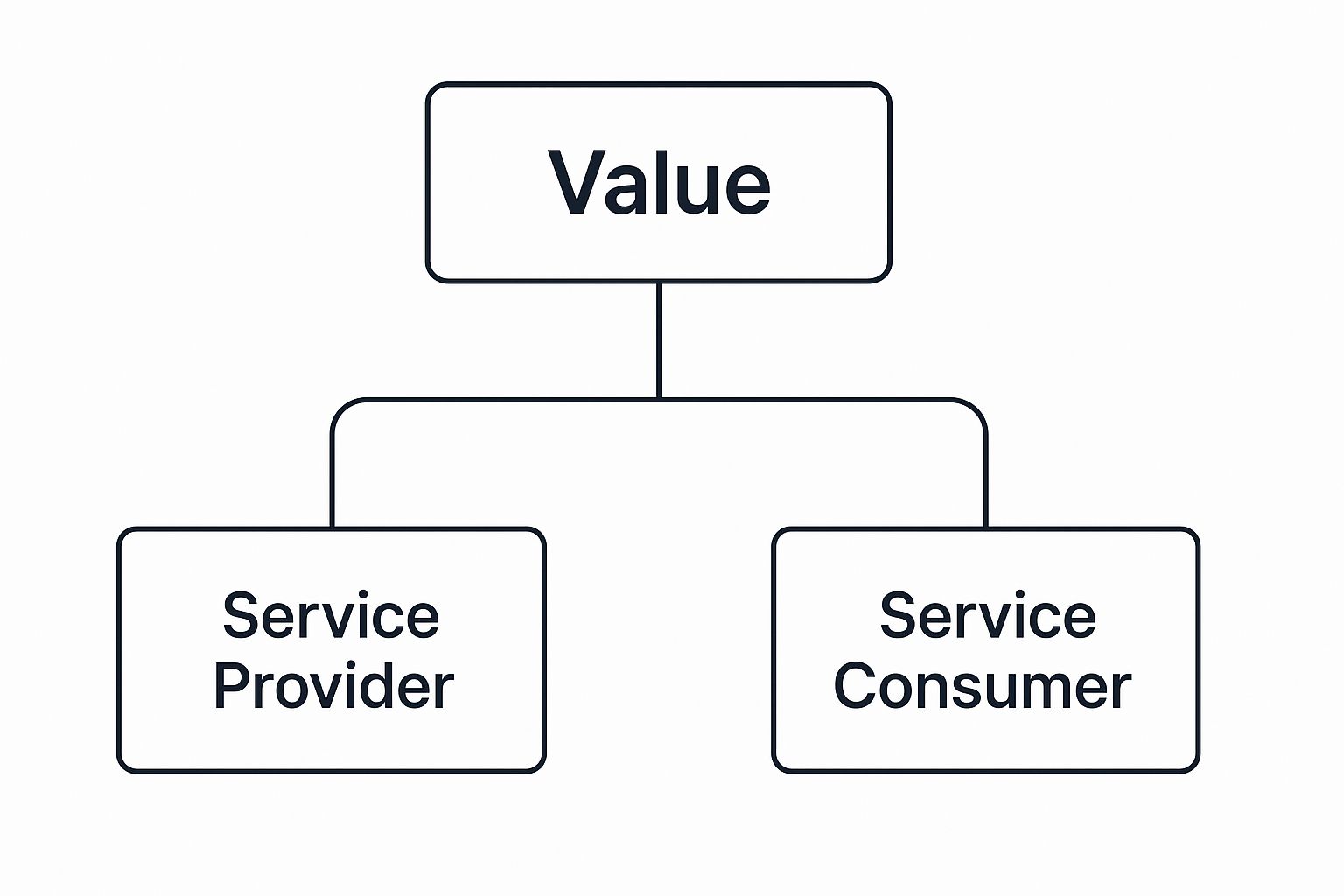
This relationship between a service provider and a consumer is all about working together to create value. It's a partnership.
 Image
Image
As you can see, value isn't something that's just built and handed over. It’s co-created, meaning both the provider and the consumer have a role to play.
The Service Value System (SVS)
The Service Value System (SVS) is the absolute heart of ITIL 4. It’s the blueprint that shows how all the different parts of an organization come together to create value through IT services. It has five core components you need to know.
1. The Guiding Principles These are the seven foundational beliefs that should guide every single decision. They’re less like strict rules and more like a shared mindset for the entire organization.
- Focus on value: If it doesn't create value for a stakeholder, why are you doing it?
- Start where you are: Don't throw everything out. Build on the good stuff you already have.
- Progress iteratively with feedback: Forget massive, risky "big bang" projects. Make small, smart changes and listen to feedback along the way.
- Collaborate and promote visibility: Break down those silos! When people see what’s going on, they make better decisions.
- Think and work holistically: Nothing exists in a vacuum. See the big picture and how everything connects.
- Keep it simple and practical: Use the most straightforward path to get things done. Cut out any steps that don't add real value.
- Optimize and automate: Let people focus on what they do best. Automate repetitive tasks to boost efficiency and reduce errors.
2. Governance This is the "how we steer the ship" component. Governance is all about directing and controlling the organization to make sure its activities actually line up with business goals. It’s how you ensure accountability from the very top.
3. The Service Value Chain If the SVS is the heart, the Service Value Chain is the engine room. It’s an operating model with six key activities for turning demand into value. These activities are: Plan, Improve, Engage, Design & Transition, Obtain/Build, and Deliver & Support.
The key here is flexibility. The Service Value Chain isn’t a rigid, step-by-step process. You can combine these activities in different ways—called value streams—to handle any situation that comes your way.
4. Practices Think of these as your professional toolkit. ITIL 4 gives you 34 practices, which are essentially collections of resources (people, processes, tech) designed to get a specific job done. They’re a more practical evolution of what used to be called "processes" in older ITIL versions.
5. Continual Improvement This isn't a one-off project; it’s a constant mindset. Continual improvement is woven into every other part of the SVS. The goal is simple: make small, ongoing improvements a natural part of everyone's daily work.
The Four Dimensions Model
To make sure you’re always thinking holistically, the SVS is supported by the Four Dimensions Model. You need to consider all four of these for any service to be successful.
- Organizations and People: This is the human side of things—company culture, roles, skills, and communication. A perfect process will still fail if the culture isn't right.
- Information and Technology: This covers all the data a service manages and the technology that makes it possible, from servers and software to cloud platforms and databases.
- Partners and Suppliers: No organization is an island. This dimension is about managing your relationships with all the other companies that help you design, build, deliver, and support your services.
- Value Streams and Processes: This focuses on how work actually gets done. It’s about mapping out the workflows and controls that ensure everything moves smoothly to create value for the customer.
These core concepts are absolutely crucial for the exam. To see how well you’ve grasped them, I’d recommend tackling some ITIL 4 foundation practice questions that zero in on the SVS and Four Dimensions. Getting comfortable with these ideas is what separates true understanding from just memorizing definitions.
Your Guide to the ITIL V4 Foundation Exam
 Image
Image
Passing the ITIL V4 Foundation exam is that final, crucial step to officially validate your newfound knowledge. Knowing exactly what to expect on test day is the difference between walking in with confidence and feeling caught off guard. Let's pull back the curtain on the entire process and break down the exam's structure, format, and content so there are absolutely no surprises.
The exam itself isn't designed to trick you with obscure details or sneaky questions. Its real purpose is to confirm you have a solid, practical grasp of the core ITIL 4 concepts—the principles, practices, and systems that make modern IT service management tick.
When you know the rules of the game, you can build a winning strategy.
Understanding the Exam Format
The ITIL V4 Foundation exam has a straightforward and consistent format. It’s a closed-book test, which means success is built on genuine understanding, not just rote memorization or the ability to quickly look things up. This really pushes you to internalize the concepts.
Here’s what you’ll be looking at on exam day:
- Question Type: 40 standard multiple-choice questions.
- Time Limit: You get exactly 60 minutes to complete the test.
- Passing Score: A passing grade requires at least 26 correct answers, which works out to 65%.
These numbers give you about 90 seconds per question. Some will be a quick gut-check, while others might need a moment of thought, so good time management is your best friend. Despite being a closed-book exam, it’s very passable—nearly 80% of candidates pass on their first attempt.
Breaking Down the Syllabus Weighting
Not all topics on the syllabus are created equal when it comes to exam questions. The questions are carefully distributed to test specific learning outcomes, and knowing this distribution is like getting the game plan before a big match. It helps you focus your study time on the areas that will score you the most points.
If you’re building your study plan, you might also want to check out our detailed guide for more exam preparation tips.
Here’s how the questions are typically spread across the key syllabus areas.
| Syllabus Area | Topic Covered | Approx. Question Count |
|---|---|---|
| Concepts of Service Management | Key definitions like value, service, and outcomes | 5 Questions |
| The Four Dimensions | Understanding the four dimensions of service management | 3 Questions |
| The Service Value System (SVS) | Purpose and components of the SVS, including Guiding Principles | 13 Questions |
| Continual Improvement | The Continual Improvement model and its relationship with the Guiding Principles | 4 Questions |
| ITIL Management Practices | Purpose of key practices (e.g., Change Enablement, Incident Management) | 15 Questions |
Key Insight: Take a close look at that table. The Service Value System and the ITIL Management Practices together make up more than two-thirds of the entire exam. Nailing these two sections is absolutely critical to passing.
This breakdown gives you a clear road map. While every topic is important, your study efforts should heavily lean into the SVS and the core management practices. By focusing your energy there, you dramatically boost your chances of hitting that 65% passing score and walking away certified.
How ITIL Certification Boosts Your Career and Salary
So, you pass an exam, get a piece of paper... what’s the big deal? What’s the real-world value of getting your ITIL V4 Foundation certification?
Think of it less like a credential and more like a complete upgrade to your professional operating system. It shifts your perspective from just doing tasks to truly understanding the "why" behind them. Suddenly, you have a powerful new lens to see your work and how it connects to the bigger business picture.
This certification is far more than just another line on your LinkedIn profile. It's a clear signal to any employer that you speak the language of business value. It shows you know how to connect day-to-day IT activities directly to business outcomes—a skill that’s incredibly rare and valuable in any tech role. It proves you can think strategically, solve problems with a service-first mindset, and work effectively across different teams.
The Financial Return on Your Investment
Let's talk about one of the most immediate and tangible benefits: the boost to your paycheck.
The ITIL framework is a globally recognized standard, and companies are more than willing to pay a premium for professionals who know how to apply it. The data shows a clear, consistent link between ITIL certification and higher salaries across all sorts of IT roles.
And we're not talking about a small bump. ITIL Foundation-certified pros often see a substantial salary increase. Some sources report an average annual income around $98,000, with the potential to hit $150,000 depending on your experience and where you live.
For example, ITIL-certified professionals in the United States earn roughly $104,388 per year. In India, that same expertise commands an average of about ₹1,232,760 annually. You can find more details on these salary insights about ITIL certification worth on gururo.com.
How Certified Professionals Drive Organizational Success
The benefits go way beyond your own career. They create a ripple effect that makes the entire organization stronger, smoother, and more predictable.
An organization where everyone understands ITIL principles is like a sports team where every player knows the playbook. The result is better coordination, fewer mistakes, and a much higher chance of winning.
When everyone shares a common language and framework, it naturally fosters a culture of collaboration and continuous improvement. Here’s how that plays out in the real world.
Key Organizational Benefits:
- Improved Service Quality: Certified teams are masters at managing incidents, problems, and changes. This leads directly to more stable services and happier customers.
- Smarter Risk Management: ITIL gives you a structured way to spot and handle risks, protecting the business from costly disruptions and failures before they happen.
- Streamlined Costs: By focusing on value and optimizing processes, certified professionals help cut out wasteful activities, making sure every dollar invested in IT delivers a real return.
- Better Alignment with Business Goals: This is the big one. ITIL ensures the IT department stops being just a cost center and becomes a true strategic partner that helps the business win.
Unlocking New Career Paths and Opportunities
Think of the ITIL V4 Foundation certification as a launchpad. It doesn’t lock you into a single role. Instead, it swings open doors to a huge range of career paths across the IT service management world.
It provides a rock-solid foundation, whether you want to dive deep into a specialty or climb the ladder into a leadership position.
If you're curious about how your own certification journey might look, you can check out a real-world example of an ITIL V4 exam history to see how it compares. Ultimately, investing in your ITIL knowledge is an investment in your own long-term career resilience and growth.
Of course. Here is the rewritten section, crafted to sound completely human-written and natural, following all your specified requirements.
A Proven Roadmap for Your ITIL 4 Exam Prep
 Image
Image
Knowing what's on the ITIL 4 Foundation exam is one thing. Knowing how to actually prepare for it is what separates a pass from a fail. You can't just memorize a bunch of terms and hope for the best; you need to genuinely understand the concepts and feel confident enough to apply them when the clock is ticking.
Think of it like training for a marathon. You wouldn’t just show up on race day and wing it. You’d have a training schedule, practice on similar terrain, and figure out your pacing. Getting ready for your ITIL exam demands that same kind of smart, strategic approach.
Here’s a game plan that’s worked for countless others.
Choose Your Learning Path
First things first: how are you going to learn this stuff? You've got two main routes, and the best one for you boils down to your learning style, budget, and how disciplined you are.
-
Accredited Training Courses: This is the most reliable path. When you sign up with an accredited training organization (ATO), you're getting a curriculum that’s guaranteed to cover the official syllabus. These courses are led by instructors who have been in the trenches, so they can answer your tricky questions and connect the concepts to the real world.
-
Self-Study: This route gives you total flexibility and is usually easier on the wallet. You can learn at your own pace using the official ITIL books, online resources, and study guides. The catch? It takes serious self-discipline to stay on track and make sure you've covered every single learning objective.
While motivated people can definitely succeed with self-study, investing in an accredited course tends to pay off. The structure and expert guidance can shave weeks off your learning time and give you a major confidence boost.
The Value of Structured Training
Let's be honest, the official syllabus is dense. Professional training providers do the heavy lifting for you by condensing it into something manageable. Most ITIL 4 Foundation certification courses pack the learning into a tight timeframe, usually offering around 12 hours of focused training.
Top-tier programs make sure their material is perfectly aligned with the latest official standards. You can even see how academic institutions structure their ITIL 4 programs for a little more insight.
Key Takeaway: An accredited course is an investment in certainty. You're not just buying study materials; you're buying a proven path that cuts out the guesswork and keeps you focused on what you actually need to know for the exam.
This structured approach is perfect if you’re trying to get certified without derailing your work schedule.
Create a Realistic Study Schedule
Once you've picked your path, it’s time to get organized. The biggest mistake people make is underestimating the time commitment. "I'll study when I have time" is a one-way ticket to stress and last-minute cramming.
Don't do that to yourself. Open your calendar and block out specific, non-negotiable times for studying, just like you would for a meeting. Be realistic, too. Shorter, focused study sessions are way more effective for long-term memory than pulling an all-night cram session.
A solid four-week plan might look something like this:
- Week 1: Get your head around the Core Concepts and the Service Value System (SVS).
- Week 2: Do a deep dive into the Guiding Principles and the Four Dimensions.
- Week 3: Master the key ITIL Management Practices (like Incident Management and Change Enablement).
- Week 4: Dedicate the whole week to practice exams, reviewing your notes, and patching up any weak spots.
Leverage Practice Exams Strategically
Practice exams are your single most important prep tool. Full stop. They do more than just test what you know—they build your mental stamina for the real thing and shine a bright light on your blind spots.
Don't just take them to see your score. Use them like a diagnostic tool.
After every practice test, dig into your results. Don't just glance at what you got wrong; figure out why you got it wrong. Was it a concept you didn't know? Did you misread the question? Did you get fooled by a tricky answer choice? That’s where the real learning happens. In fact, we built HydraNode to do just that—our AI-driven practice tests help you pinpoint and fix those exact weaknesses.
Connect with the ITIL Community
Remember, you're not going through this alone. Thousands of people are studying for this exam right now or have just passed it. Tapping into that community is a massive advantage.
Jump into ITIL forums on LinkedIn or Reddit. You can ask questions, swap study tips, and get a boost from people who know exactly what you're going through. Hearing about someone else's "aha!" moment or how they avoided a common pitfall can save you a ton of time and frustration.
Got Questions About ITIL 4 Foundation? We've Got Answers.
Alright, so you're getting serious about the ITIL 4 Foundation certification. It's totally normal to have a few last-minute questions bubbling up as you get ready to commit. Let's clear the air and tackle some of the most common ones I hear from people just like you.
Think of this as our final chat before you dive in, making sure you have all the pieces of the puzzle locked in place.
Are There Any Prerequisites?
This is easily the most asked question, and the answer is refreshingly simple: Nope. There are zero formal prerequisites to sit for the ITIL 4 Foundation exam.
You don't need a fancy degree, a specific number of years in IT, or a collection of other certs to get started. The Foundation level was built from the ground up to be the front door to the ITIL framework. It assumes you're coming in fresh, with little to no prior ITIL knowledge.
Sure, a bit of hands-on IT experience can help you connect the dots to real-world scenarios, but it's absolutely not a deal-breaker. The course and exam are designed to teach you everything you need to know, making it a great fit for seasoned pros and career-changers alike.
What Career Paths Does This Certification Actually Open Up?
The ITIL 4 Foundation cert isn't a key to just one door—it's more like a master key that opens up a whole hallway of them. Because ITIL’s ideas touch the entire lifecycle of a service, this certification adds a ton of value to a surprisingly wide range of roles.
Instead of boxing you into a single job title, it gives you a versatile way of thinking that makes you a much stronger candidate for all sorts of positions.
- IT Support Analyst / Service Desk Engineer: You'll finally have a framework for managing incidents and service requests that focuses on creating real value for users, not just closing tickets.
- Business Analyst: ITIL gives you the language and the models to better connect what IT delivers with what the business actually needs.
- IT Project Manager: You'll become much better at delivering projects that don't disrupt ongoing services, especially when you master concepts like Change Enablement.
- DevOps Engineer: The core principles of collaboration, keeping things visible, and improving iteratively with feedback are the heartbeat of both ITIL 4 and DevOps.
- IT Manager / Team Lead: You'll gain a shared vocabulary and a proven framework to guide your teams toward better service delivery and continuous improvement.
The certification is your proof that you know how to connect technical work to business results—a skill that’s desperately needed in almost any role that involves technology services. It’s a foundational layer that makes you more effective, no matter what your job title is.
How Is ITIL 4 Different from ITIL v3?
If you’ve been knocking around the IT world for a bit, you’ve probably heard of the older version, ITIL v3. The jump to ITIL 4 wasn't just a fresh coat of paint; it was a fundamental shift in thinking. It builds on the solid ideas of its predecessor, but it represents a genuine evolution.
Here’s a quick breakdown of what really changed.
| Aspect | ITIL v3 | ITIL 4 |
|---|---|---|
| Core Focus | A rigid, process-heavy lifecycle. | A flexible, value-driven system. |
| Key Model | The Service Lifecycle (Strategy, Design, Transition, Operation, CSI). | The Service Value System (SVS) and the Service Value Chain. |
| Guiding Idea | Following a structured, almost linear process. | Co-creating value through guiding principles and flexible value streams. |
| Integration | Tended to operate in its own silo. | Designed from the start to integrate with Agile, DevOps, and Lean thinking. |
The biggest leap forward is the move away from rigid, prescriptive processes to a set of flexible Guiding Principles. ITIL 4 encourages you to "think and work holistically" and "progress iteratively with feedback," which makes it a much better fit for the speed of modern business.
Ready to stop just studying and start mastering the concepts? HydraNode uses an advanced AI-driven platform to create practice tests that adapt to your unique knowledge gaps. Pinpoint your weaknesses, build your confidence with our real-time exam engine, and walk into your ITIL 4 Foundation test fully prepared to pass. Start your smarter study plan today at https://www.hydranode.ai.